
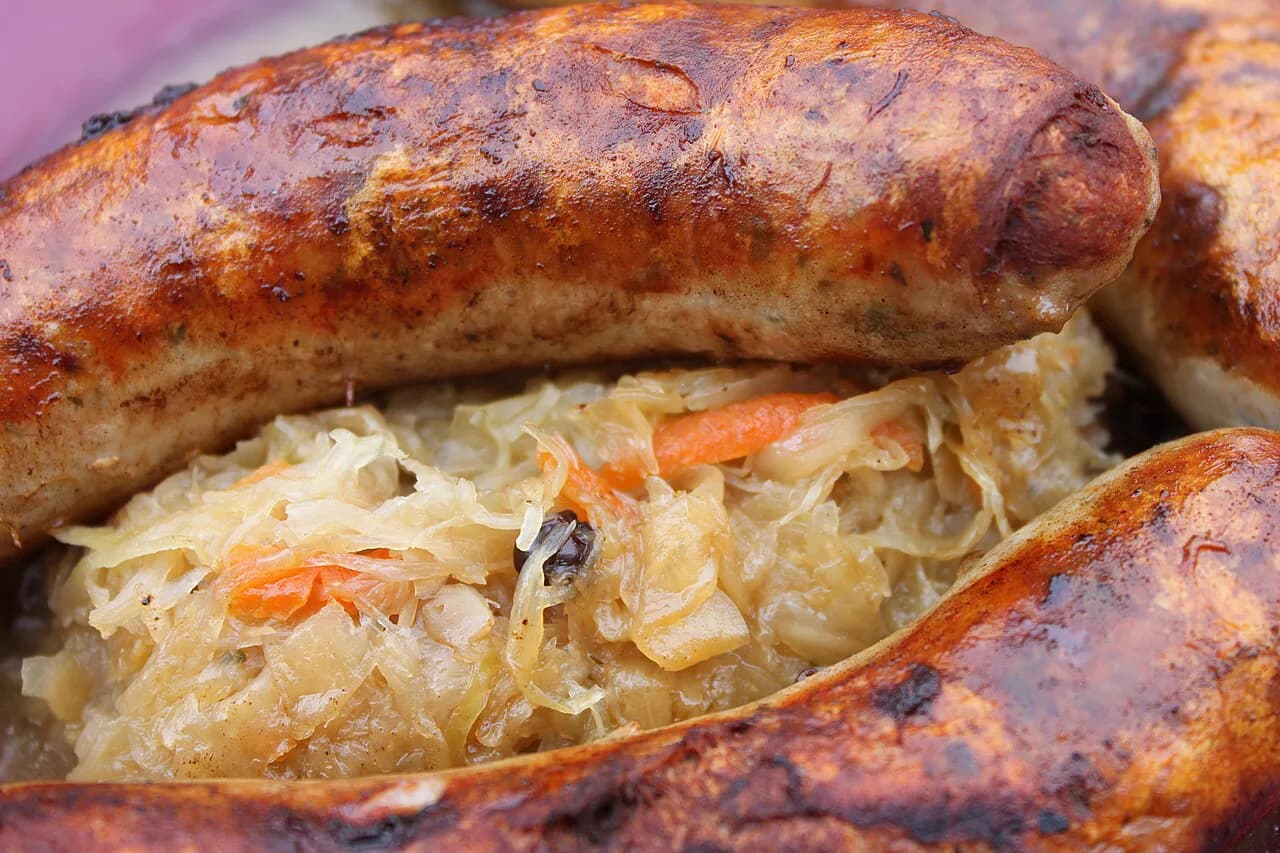
German Food: The Dishes to Know and What to Order
German food goes well beyond sausage and sauerkraut. Learn the dishes travelers should know by region, what each one is, and how to order it in a Gasthaus or Imbiss.
On this page
German food is regional cooking, and the plate in front of you in Bavaria looks little like the one in Hamburg or the Rhineland. The dishes travelers hear about most are sausage in its many forms, Spätzle and Knödel, potato salads, braised and roasted meat, and a serious baking tradition built on rye and wheat. This guide sorts those dishes by region and by setting, so you know what to order, where it belongs, and which beer to put next to it.
Treat the menu as a set of local habits rather than a checklist. A Munich beer hall, a Cologne brewery tap and a Black Forest Gasthaus each organize a meal differently, and the same word can mean a different plate from town to town.
What German food actually is: a regional cuisine, not one national menu
Germany has no single national menu. The cooking changes with the landscape and the history of each region, from the pork-and-dumpling tables of the south to the fish and potato dishes of the coast and the Rhineland's sweet-sour braises. German cuisine also absorbed neighbors and immigrants over centuries, which is why a Döner kebab counter sits beside a traditional bakery on most shopping streets.
For a traveler, that means the city you are standing in should decide what you eat. Order Weißwurst in Munich, Labskaus in Hamburg, and a Rhineland braise in Cologne, and the meal will make sense of the place. Trying to find one definitive German dish mostly leads to mediocre versions of everything.
Bread and Brezeln: the baking that anchors a German day
Bread is the quiet foundation of German eating, and the country's bakers work mostly with rye and wheat in dense, dark loaves and in small rolls meant to be split and buttered. A bakery counter in the morning is where you see the range: seeded rolls, sourdough rye, and the knot-shaped pretzel.
What is Germany's national dish? Germany has no single national dish. The cooking is regional: pork and dumplings in Bavaria, fish and potatoes in the north, braises in the Rhineland, and Prussian classics in Berlin.
Is German food only meat and potatoes? No. Meat and potatoes are central, but the table also runs on rye and wheat bread, Spätzle and cheese noodles, lentil and vegetable soups, cold sausage salads, sauerkraut and pickles, and a strong bakery and cake tradition.
What is the difference between an Imbiss and a Gasthaus? An Imbiss is a counter or kiosk for quick food such as currywurst, fries, Döner kebab or a fish sandwich, often eaten standing. A Gasthaus is a sit-down neighborhood restaurant with table service, plated mains and sides, where dishes like Schnitzel, Sauerbraten or Königsberger Klopse belong.
The pretzel, Brezeln in German, uses only flour, malt, salt, yeast and water before it is knotted, briefly boiled and baked to a dark, chewy crust. In Bavaria it arrives at the beer hall as a palm-sized knot beside a spread like Obatzda, the mashed camembert and butter beer cheese seasoned with paprika and onion. Order one to share before the main plate; it is the cheapest way to taste what a region's baking is about.
Sausages: Bratwurst, Weißwurst, Currywurst and how they are served
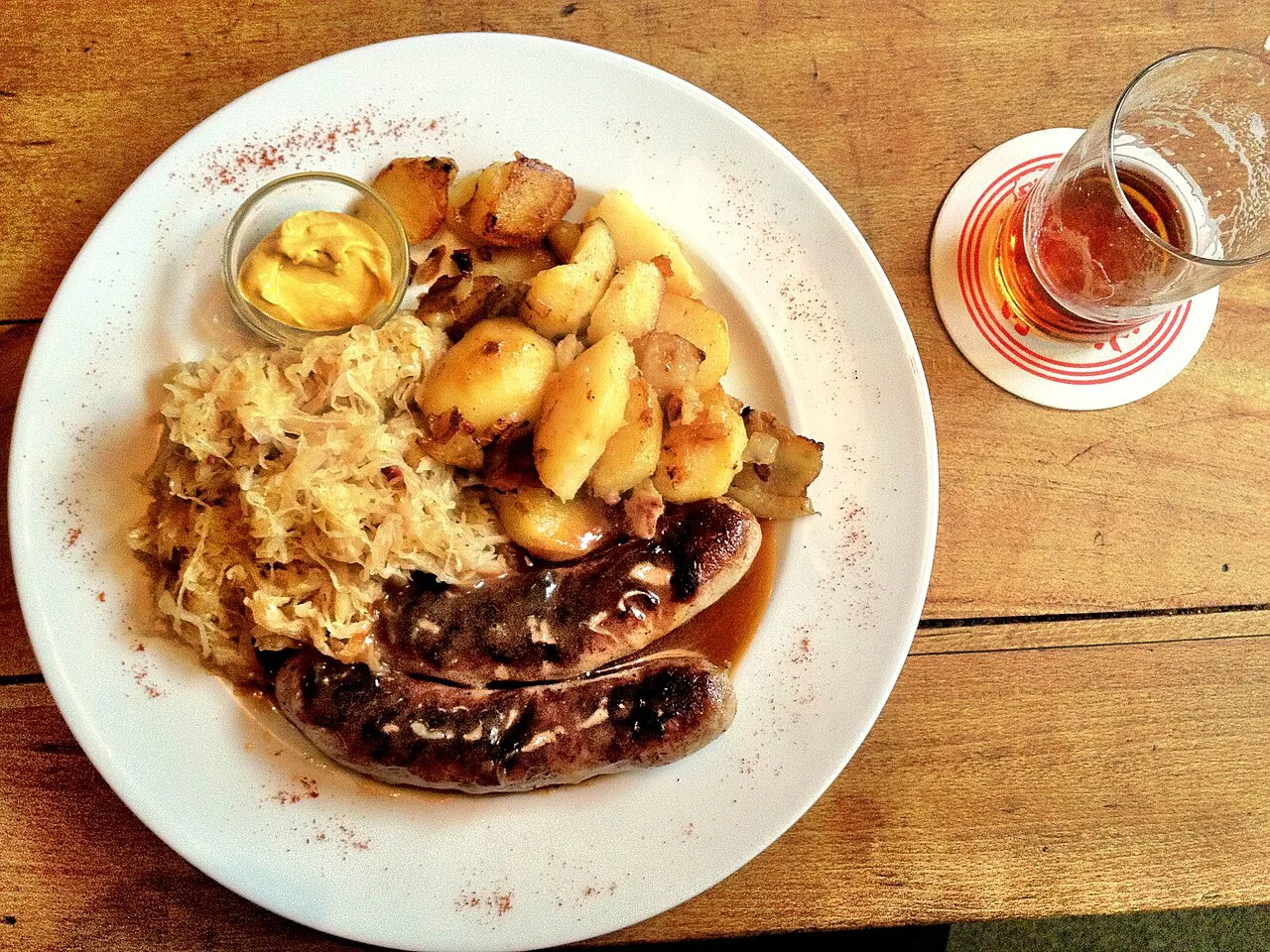
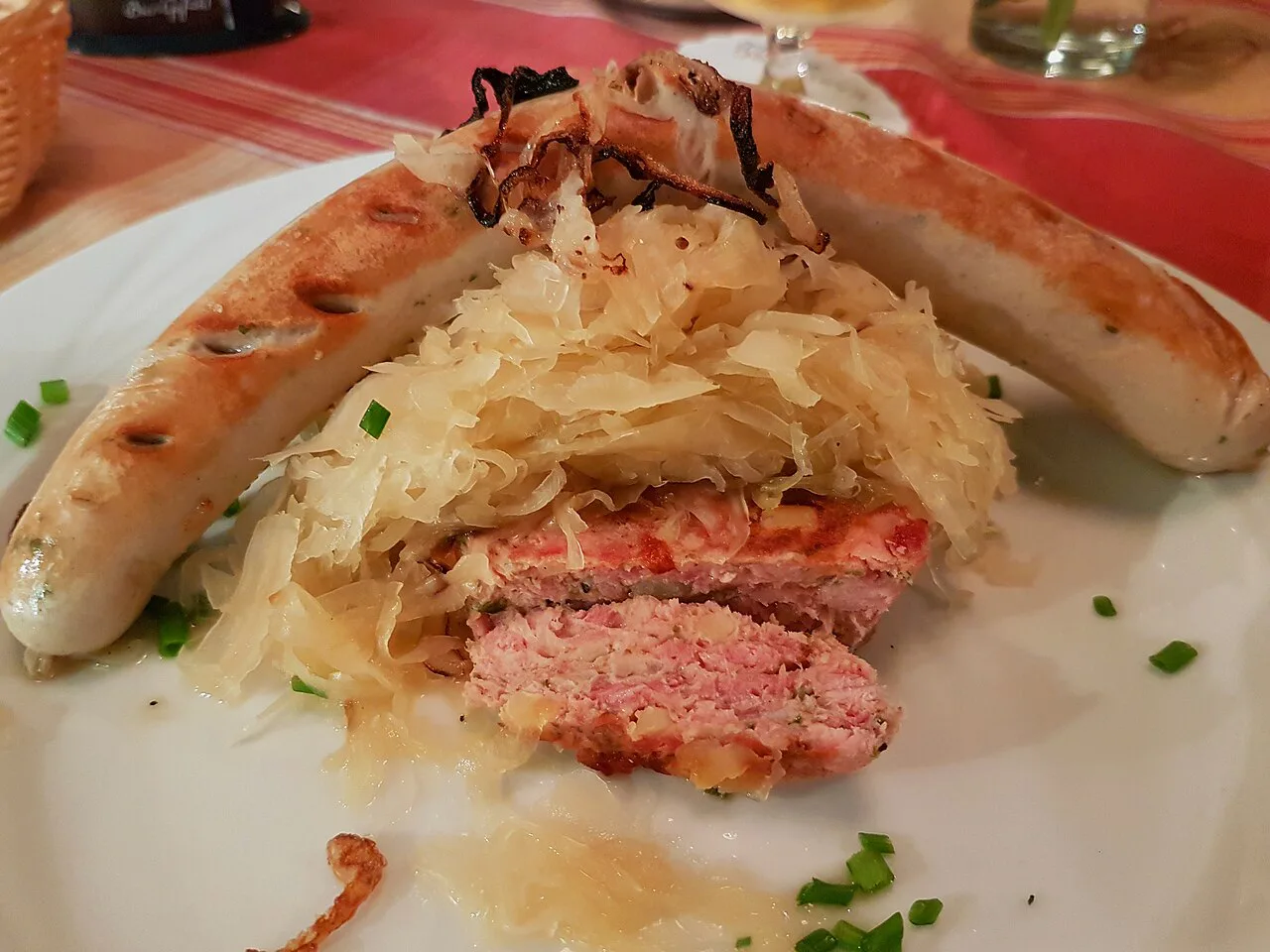
Sausage is where German regionalism shows most clearly. Bratwurst is the generic grilled sausage, and it changes length, coarseness and spice from one region to the next, always served with mustard and usually a roll. Weißwurst is the pale, soft Munich veal sausage, traditionally eaten before noon with sweet mustard, a pretzel and a wheat beer, and the skin is peeled off rather than eaten.
Currywurst is the Berlin and Ruhr street-food standard: a sliced sausage under curry ketchup and curry powder, eaten standing at an Imbiss counter with a paper fork. Leberwurst is a soft, spreadable liver sausage eaten on bread, and it is a pantry staple rather than a restaurant centerpiece. Ask for what the counter does best and let the format tell you: a paper tray means street food, a plate means a sit-down portion.
The offal question: Leberwurst, Leberknödelsuppe and what you are ordering
Some German dishes use liver and other offal plainly, without disguising it. Leberknödelsuppe is a clear broth with a large liver dumpling floating in it, a common starter in Bavarian and Franconian Gasthäuser and one of the mildest ways to meet liver flavor. If you like pâté, you will probably like it.
Order offal dishes as a starter rather than a main if you are unsure, because the portions are usually smaller and the flavor is easier to judge. Soups and dumplings are also where a kitchen's skill shows most clearly. If liver is not for you, the broth-based soups and the cheese spreads will carry a first course just as well.
Käsespätzle and Spätzle: the southwest's noodle staple
Spätzle are small, soft egg noodles scraped into boiling water, and they appear across southern Germany as a side or a base for a main. Käsespätzle tops them with melted cheese and fried onions, which makes a full vegetarian plate rather than a garnish. In Swabia the noodle is often the point of the dish, served with butter and a brown sauce alongside a roast.
Look for Spätzle on menus in Stuttgart, Ulm, Augsburg and the Black Forest, where the noodle tradition is strongest. A Gasthaus that makes them by hand will list them as hausgemacht, meaning house-made. Order a portion as a side to a braise and you get both textures on one plate.
Knödel, Kartoffelsalat and the side-dish logic of a German plate
A German main usually arrives with two sides, and the pairing is deliberate. Knödel are boiled dumplings, most often made from stale bread in the south or from potato further north, and they soak up gravy rather than adding flavor of their own. Kartoffelsalat, potato salad, comes in two broad styles: a northern version dressed with mayonnaise and a southern one with oil, vinegar, stock and onion.
Knowing the style tells you what you are getting. In Bavaria a Schnitzel often comes with the vinegar-based salad and a lemon wedge, while a Berlin or Hamburg plate may pair meat with the creamy version. If you only want one starch, say so when ordering; German kitchens are used to swapping sides.
Schnitzel, Sauerbraten and Schweinshaxe: the big meat mains
The three meat dishes travelers ask about most are the breaded cutlet, the marinated braise and the roasted pork leg. Schnitzel is a thin cutlet pounded flat, breaded and fried, and the Viennese version is veal while most German menus serve pork; the full picture of cuts, panade and regional variants is in the guide to Schnitzel in Germany.
Sauerbraten is beef marinated for days in vinegar, wine and spices, then braised and served with a dark, tangy gravy, a dish that turns up on Sunday tables across the Rhineland and Swabia. Schweinshaxe is the roasted pork knuckle, with crackling skin and a portion built for sharing, and the details of cuts and sides are in the Schweinshaxe guide.
Order the cutlet at lunch if you want a smaller plate and the knuckle at dinner when you have time and appetite. A braise like Sauerbraten is often better on the second day of a batch, so ask what the kitchen cooked that morning. These are heavy plates, and sharing a starter is normal rather than stingy.
Labskaus and the northern fish and potato table
Northern Germany eats from the sea and the potato field. Labskaus is a mash of corned beef, potato and beetroot, usually served with a fried egg and a rollmop herring on the side, a sailors' dish that looks alarming and tastes mild and savory. The north is also where Fischbrötchen, a fish sandwich on a crusty roll with onion, belongs as a quick lunch near the harbor.
In Hamburg and the coastal towns, look for the fish counter at lunch and the potato-and-pork plates at dinner, with Rollmops, a pickled herring roll, as a sharp starter. Grünkohl, kale cooked slow with sausage and bacon, is the winter plate of the region and appears on menus from late autumn into the new year.
Königsberger Klopse, Eisbein and Berlin's own classics
Berlin's classic table mixes Prussian and eastern European cooking. Königsberger Klopse are veal meatballs poached in a broth sharpened with vinegar, lemon and capers, then finished with a creamy sauce, and they carry the name of a city that is now Russian Kaliningrad. Eisbein is the boiled or roasted pork knuckle, cured and served with sauerkraut and pea puree, and it differs from the southern roasted Haxe in cure and cooking method.
Order the Klopse with boiled potatoes and the Eisbein only if you are hungry, since the portions are large. In the Rhineland the same sort of comfort cooking shows up as Himmel und Erde, a mash of apple and potato with fried black pudding and onions, a sweet-savory plate that visitors either love or hand to a companion.
Krauts, pickles and Salate: what comes alongside
Sauerkraut is fermented cabbage, tangy and soft, and it arrives next to sausage, pork and dumplings as a counterweight rather than a dish on its own. The same logic drives the pickles: a sour gherkin beside a plate of cold cuts or a jar of Rollmops, and the cucumber salad that turns up on every seasonal menu.
Cold plates are where these sides do most of the work. A Wurstsalat is sliced sausage in vinegar and onion, a meat salad that functions as a light lunch, and it is served with bread rather than potatoes. Order one with a beer at midday and you have the cheapest of the traditional meals, with no cooking weight to it at all.
Cakes and desserts: Schwarzwälder Kirschtorte, Apfelstrudel and Krapfen
The German afternoon is built around coffee and a slice of cake, and the Konditorei, a pastry café, is a proper institution. Schwarzwälder Kirschtorte, Black Forest cake, layers chocolate sponge with cream, sour cherries and kirsch, and its name points to the Black Forest region rather than to any protected recipe. Apfelstrudel is the thin-pastry apple roll, warm, dusted with sugar and served with vanilla sauce or cream.
Krapfen are the filled, fried doughnuts eaten year-round at German bakeries and cafés, dusted with sugar and filled with jam or custard, and they sit beside the German Christmas food guide's seasonal dark breads of the colder months. For a weekend table, German pancakes are closer to the American idea than a French crêpe: wide, thin and folded onto the plate, a Bavarian version that is worth ordering for brunch.
Order a slice mid-afternoon, when the café fills up, rather than after a heavy dinner. If the counter has a cake of the day, take it; that is where the baking is freshest. In the Black Forest, a café serving cherry cake is doing what its region is known for, so it is a better buy than a generic chocolate dessert.
Beer styles to order with the food
German beer has regional styles tied to the local table. Kölsch, the pale, top-fermented beer from Cologne, arrives in small glasses and is served by a waiter who keeps replacing the empty one until you cover it. Altbier is the darker, malty counterpart from Düsseldorf, and Weißbier is the wheat beer of Bavaria, cloudy and fruity, the correct partner to Weißwurst.
Pilsner is the crisp, bitter lager found everywhere and a safe pairing for fried and breaded dishes. In Bavaria a beer garden lets you bring a snack and order the beer by the half-liter, while a brewery tap like the ones in Cologne and Düsseldorf serves one house style only. Which beer hall or garden fits your evening is the subject of the Biergarten in Germany guide.
Drink a half-liter with a meal rather than refilling fast, and try the local style before ordering a familiar brand. If a tap serves only one beer, that beer is the house recommendation and the food is cooked to match it.
What to eat in Bavaria versus the Rhineland versus the north
Bavaria is the land of wheat beer, pretzels, Weißwurst, dumplings and roasted pork. The Rhineland eats more braises, root vegetables and sweet-sour combinations, with mustard and pickled things on the side, and the north leans on fish, potatoes, kale in winter and rye bread. Berlin mixes in its own Prussian classics, and Swabia contributes the noodle dishes.
Plan the trip around this. If your route runs from Munich to Hamburg, you are eating three different cuisines, and the same word may still appear on every menu. Pick the regional dish once in each place and let the rest of the meal follow the local pattern: soup and a main at lunch, cake in the afternoon, one plate of meat or fish at dinner.
This is also where a braise recipe pays off: with sour cream and a dark gravy, the German approach to cooking beef is closer to a Sunday pot roast than to a restaurant production.
Imbiss versus Gasthaus: where you eat which dish
The Imbiss is a snack counter, often a hut or a kiosk with standing tables, where sausage, currywurst, fries, Döner kebab and fish sandwiches are sold to be eaten quickly. The Gasthaus is the sit-down neighborhood restaurant, with a printed menu, table service and a kitchen that cooks to order. The same country produces both, and travelers who only visit one get half the picture.
Match the format to the food. Currywurst and Fischbrötchen belong at the counter, where they are cooked to order and eaten standing. Schnitzel, Sauerbraten, Klopse and larger roasts belong at a table, where the sides and sauce come plated. A bakery is a third format, best for breakfast and the afternoon cake, with a few tables and a coffee machine.
For the morning meal, German breakfast at a bakery or a café is usually bread, rolls, cold cuts, cheese and coffee rather than eggs. In the Rhineland, a waffle breakfast is a weekend tradition worth seeking out for a slower start.
Lunch is often the better value meal at a Gasthaus, with smaller portions of the same dishes, and dinner is when the roast and the knuckle come out. If a place has a chalkboard of the day's dishes, order from it rather than the printed menu.
How to order and pay at a German table
At a Gasthaus, a server seats you or waves you to a free table, and you order drinks first. The menu terms you need are Vorspeise for a starter, Hauptgericht for a main and Beilage for a side. Many kitchens list a Tagesgericht, a dish of the day, on a board or a slip of paper, and that is usually the freshest thing on offer.
Payment is at the table when you are ready to leave, and you signal the server rather than waiting at a counter. Cash is still common at smaller places, so carry euros even if you plan to pay by card. Tipping is rounded up rather than calculated, and saying zusammen bitte tells the server you are paying for the whole table.
To eat like a local at lunchtime, order the main and a drink and skip the starter; the big plates are designed to be a full meal. If the menu is in dialect, ask what the dish is, and the answer will usually come with what it is served with. That is the fastest way to learn a region's food, one plate at a time.
Which German dish to order first
Start with the regional signature of the city you land in: Weißwurst at a Munich morning table, a Fischbrötchen on the Hamburg harbor, Königsberger Klopse in Berlin, Sauerbraten in Cologne. Then add one sausage at an Imbiss and one cake in the afternoon, and you have covered the three formats that structure a German eating day.
Leave the big roast for a dinner when you have time, order the local beer with it, and let the sides do the regional talking. That approach costs less than chasing a checklist and gets you closer to how the country actually eats.
Explore more Germany guides
- German Christmas Food
- German Pancakes
- Grünkohl: Germany's Winter Kale Dish and How to Eat
- Himmel und Erde
- Kaiserschmarrn
- Königsberger Klopse
- Labskaus
- Obatzda: What It Is, How It Tastes and How to Order
- Rouladen
- Sauerbraten: What It Is, How It's Made, and How to Order
- Schnitzel in Germany
- Schweinshaxe
Frequently Asked Questions
What is Germany's national dish?
Germany has no single national dish. The cooking is regional: pork and dumplings in Bavaria, fish and potatoes in the north, braises in the Rhineland, and Prussian classics in Berlin. Pick the dish of the region you are visiting instead of looking for one national plate.
Is German food only meat and potatoes?
No. Meat and potatoes are central, but the table also runs on rye and wheat bread, Spätzle and cheese noodles, lentil and vegetable soups, cold sausage salads, sauerkraut and pickles, and a strong bakery and cake tradition. Vegetarian plates exist in most Gasthäuser, with Käsespätzle the most reliable order.
What is the difference between an Imbiss and a Gasthaus?
An Imbiss is a counter or kiosk for quick food such as currywurst, fries, Döner kebab or a fish sandwich, often eaten standing. A Gasthaus is a sit-down neighborhood restaurant with table service, plated mains and sides, where dishes like Schnitzel, Sauerbraten or Königsberger Klopse belong.
Sources
Notes for your next German food trip
Optional updates to our guides.
You might also like



Continue reading
More guides you'll find useful





