
Fish in Germany: What to Eat and Where
Fish in Germany runs from North Sea herring and Fischbrötchen to freshwater carp and trout. Learn the dishes to order and what they are.
On this page
Start with a Fischbrötchen, a fish sandwich on a hard-crusted white roll, a simple and widely available introduction to how Germany handles fish. From there the map splits in two: herring, North Sea shrimp and smoked fish along the northern coast, and freshwater carp and trout from inland ponds. This guide walks through the dishes worth ordering, what each one actually is, and which part of the country each belongs to.
Herring is the thread that ties the story together. Pickled herring's popularity picked up around the 12th century and it became the one seafood to reach inland Germany early, because salt preservation let it travel without spoiling. That history explains why a pickled herring roll shows up in places far from any coast.
Why fish matters in German cooking
Germany has only one coastal strip, in the north, so for centuries fresh sea fish was a regional privilege rather than a national habit. Northern German cooking built real dishes around fish while inland kitchens worked with what their ponds and rivers produced. The result is a cuisine where the fish you eat depends heavily on where you are standing.
Pickled herring broke that geographic limit. Because salt preservation let fish travel inland without spoiling, herring became a nationwide staple while fresh sea fish later turned into a delicacy. If you order one fish dish in Germany without knowing the region, make it herring.
Freshwater fish never lost its standing either, thanks partly to pond farming. Carp have been bred in ponds around the country for centuries, and trout remains a menu staple in the south and center. That gives travelers a genuine choice between coastal and inland fish traditions rather than one national fish dish, and it is the same fault line that runs through German regional cuisine as a whole.
Fischbrötchen: the fish sandwich to start with
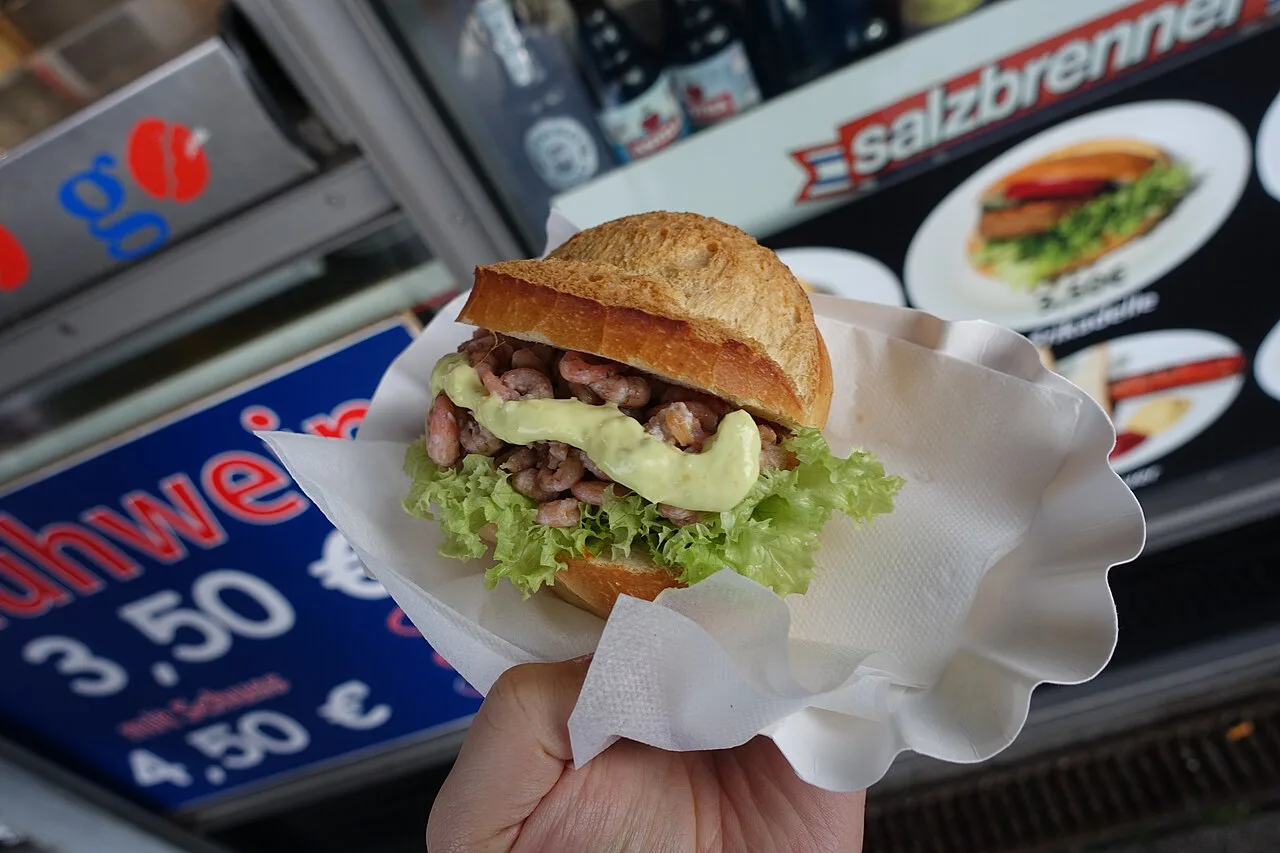
A Fischbrötchen, sometimes called a Fischsemmel, is a thick piece of pickled fish stuffed into a white roll with a hard, crunchy crust. It is simple, fast and eaten standing up, which makes it the natural first order on a northern harbor walk or at a market stall.
What fish do Germans eat most? Herring is the most established traditional seafood, pickled and salted for centuries. Sea fish such as cod and pollock and freshwater carp and trout are all common on German menus, so which one you see most depends on the region.
How much fish do Germans eat per person? Seafood consumption in Germany has grown since the 1980s, partly because fish has become relatively more affordable than meat and partly because more people see it as a lean protein. Exact annual figures change year to year.
Where do I find good fish in Germany? Go where the fish is landed or smoked. Northern port towns are the place for herring, North Sea shrimp and smoked fish sold at stalls, while inland pond country is where carp and trout belong.
Pickled herring is the classic filling, but Atlantic cod, mackerel, pollock and salmon have all become common alternatives in recent decades. If you dislike the sharp vinegar tang of pickled herring, ask for one of the others and you still get the same format with a milder fish. Toppings vary by stall, so order what looks good and pay attention to whether the fish is marinated or smoked.
The roll fits a coastal day well: it costs little, needs no reservation and leaves room for a proper sit-down meal later. In the northern port towns you will also find the coastal kitchen's other staples, from herring plates to smoked fish, on the same stalls and in the same taverns.

Herring in its forms: Rollmops, Brathering, Matjes and pickled herring
Herring appears under several names, and each one is a different preparation rather than a synonym. Rollmops is a rolled pickled herring fillet, usually wrapped around a piece of pickle or onion. Brathering is herring that has been fried and then marinated in vinegar, so it arrives cooked but still sharp. Matjes is young, lightly salted herring, milder and softer than the vinegar-cured kind, and Matjessalat turns it into a creamy salad with onion and pickle.
Order Rollmops or Brathering when you want acidity to cut through a heavy meal, and Matjes when you want something gentler. Matjessalat works well as a starter or a light lunch with bread. Pickled herring in its plainest form is the most accessible version and the one most likely to appear on a simple cold plate.
A herring plate usually comes with bread, onion and pickle rather than a hot side, so it suits a midday stop. If you want it as a starter before a meat main, order the smallest portion on offer and keep the main course light.
Krabbenbrötchen and Krabbensuppe: the North Sea shrimp dishes
Nordseekrabben, the small brown shrimp caught off the northern coast, are a prized local ingredient rather than a cheap filler. They show up in a Krabbenbrötchen, the shrimp version of the fish roll, and in Krabbensuppe, a shrimp soup that suits cold weather on the coast. Both are worth seeking out in northern port towns where the shrimp are landed.
Shrimp dishes cost more than a herring roll because the peeling is labor intensive and the catch is regional. Treat a Krabbenbrötchen as a small splurge and check the day's price at the stall before ordering, since shrimp prices move with the season.
Smoked fish and where it fits into a meal
Räucherfisch, smoked fish, is a mainstay of northern fish eating alongside pickled herring and fresh shrimp. It is sold at smokehouses and market stands, often eaten with bread and a little horseradish or onion rather than as a plated restaurant course. Mackerel and trout are common smoked choices.
Because smoked fish keeps well, it travels inland and appears on cold plates far from the coast. If you see a fish counter with whole smoked specimens, ask which one is local and which was brought in, then take it with bread for a simple lunch.
Smoked trout makes a good bridge to the south, where freshwater fish is the norm. If you are traveling through the Black Forest, a smoked fish with bread is an easy lunch that needs no kitchen.
In Franconia, freshwater fish such as carp and trout turn up on traditional menus alongside the region's sausage and beer culture, so a fish course can sit comfortably in an otherwise meat-led meal.
Karpfen in Biersoße: freshwater carp from inland ponds
Karpfen in Biersoße is carp braised in a beer sauce, a dish that belongs to inland pond country rather than the coast. Carp farming has a long history in Germany, with fish raised in dedicated ponds for centuries. The meat is firm, slightly earthy and best when the kitchen knows how to cook it.
Treat carp as a regional and often seasonal tradition, not a default menu item you will find everywhere. Where it is served it is usually a substantial main course with a sauce and a starch, so it suits a sit-down meal rather than a quick bite.
Pond country also produces the side dishes that go with carp, typically dumplings or potatoes, and the same kitchens serve the region's other hearty standards. In Franconia, carp and trout appear on traditional menus beside the region's sausages.
Steckerlfisch: grilled fish on a stick
Steckerlfisch is a whole fish skewered on a stick and grilled over an open fire, a format associated with outdoor eating and beer-garden season in the south. The skin crisps, the flesh stays moist, and you eat it with your hands. It is one of the most direct ways to taste freshwater fish in Germany.
Order it where you see a grill working, since it is cooked to order and does not sit well. Pair it with a radish salad or a pretzel and keep the rest of the meal light. In beer gardens, a grilled fish is a good counterweight to the heavier meat dishes on offer.
Bavarian menus pair grilled fish with the same sides that come with the region's roasts, so bread, potato salad or a pretzel can round out a full meal.
Fischstäbchen and everyday fish in German homes
Fischstäbchen, breaded fish sticks, are the everyday face of fish in Germany and a familiar supermarket staple. They are not a restaurant dish to hunt down, but they explain why fish appears on family tables even where fresh fish is not a local tradition. The country's fish counters are stocked from the North Atlantic and beyond, so cod, herring, pollock and salmon all turn up far from any coast.
Fish sticks pair with the same sides as other quick German meals, which usually means potatoes in some form and a cold sauce. That makes them an easy fallback for a self-catering lunch rather than a dish to plan a day around.
North vs. south: how fish eating changes across the country
In the north, fish is coastal business: herring, shrimp and smoked fish sold at stalls and eaten with bread. Inland, the emphasis shifts toward pond and lake fish such as carp and trout, often served in a sauce or grilled whole. Traveling between the two is the fastest way to see the split.
Moving south, the fish tradition narrows to specific dishes and occasions rather than an everyday habit. In Bavaria, grilled fish and trout appear alongside the meat-heavy standards of the region, which makes a fish meal a deliberate choice.
The same split runs through other regional kitchens, so pairing a fish dish with the local specialty tells you more about the place than any single menu item.
Freshwater versus sea fish in German menus
Sea fish has become standard nationwide: canned tuna sits in supermarkets and salmon appears on most restaurant menus, high-end or not. Freshwater fish nevertheless remains a bit more popular overall, thanks to pond farming and a long tradition of carp and trout. When you scan a German menu, expect both to appear.
The practical rule is to order the fish of the region you are in. Herring and shrimp on the coast, carp and trout inland, and smoked fish wherever a smokehouse operates.
In the south, freshwater fish often shares a menu with the region's dumplings and roasts, so you can order a fish course and still taste the local staples. In Franconia, that means carp or trout alongside sausage and dark beer.
In the Rhineland, fish is less central, but a fish course can still anchor a meal built around the region's other specialties.
Which fish dish should you order first?
Order a Fischbrötchen first. It is the easiest entry point, it is cheap, and it tells you immediately whether you like pickled herring or should move to cod, pollock or salmon. After that, let geography make the choice: herring, shrimp or smoked fish in the north, carp or trout inland.
If you only have one sit-down fish meal, pick carp in beer sauce in the ponds region or a grilled Steckerlfisch in the south, and build the rest of the day around that choice.
Explore more Germany guides
Frequently Asked Questions
What fish do Germans eat most?
Herring is the most established traditional seafood, pickled and salted for centuries. Sea fish such as cod and pollock and freshwater carp and trout are all common on German menus, so which one you see most depends on the region.
How much fish do Germans eat per person?
Seafood consumption in Germany has grown since the 1980s, partly because fish has become relatively more affordable than meat and partly because more people see it as a lean protein. Exact annual figures change year to year.
Where do I find good fish in Germany?
Go where the fish is landed or smoked. Northern port towns are the place for herring, North Sea shrimp and smoked fish sold at stalls, while inland pond country is where carp and trout belong. Order the fish of the region you are in.
Are there goldfish in Germany?
Goldfish are a freshwater fish kept as a pet, not a food fish, and do not appear on menus. Germany's food fish are herring, cod, pollock, salmon, mackerel and shrimp from the sea, plus carp and trout from freshwater ponds and lakes.
Sources
Notes for your next German food trip
Optional updates to our guides.
You might also like



Continue reading
More guides you'll find useful




