
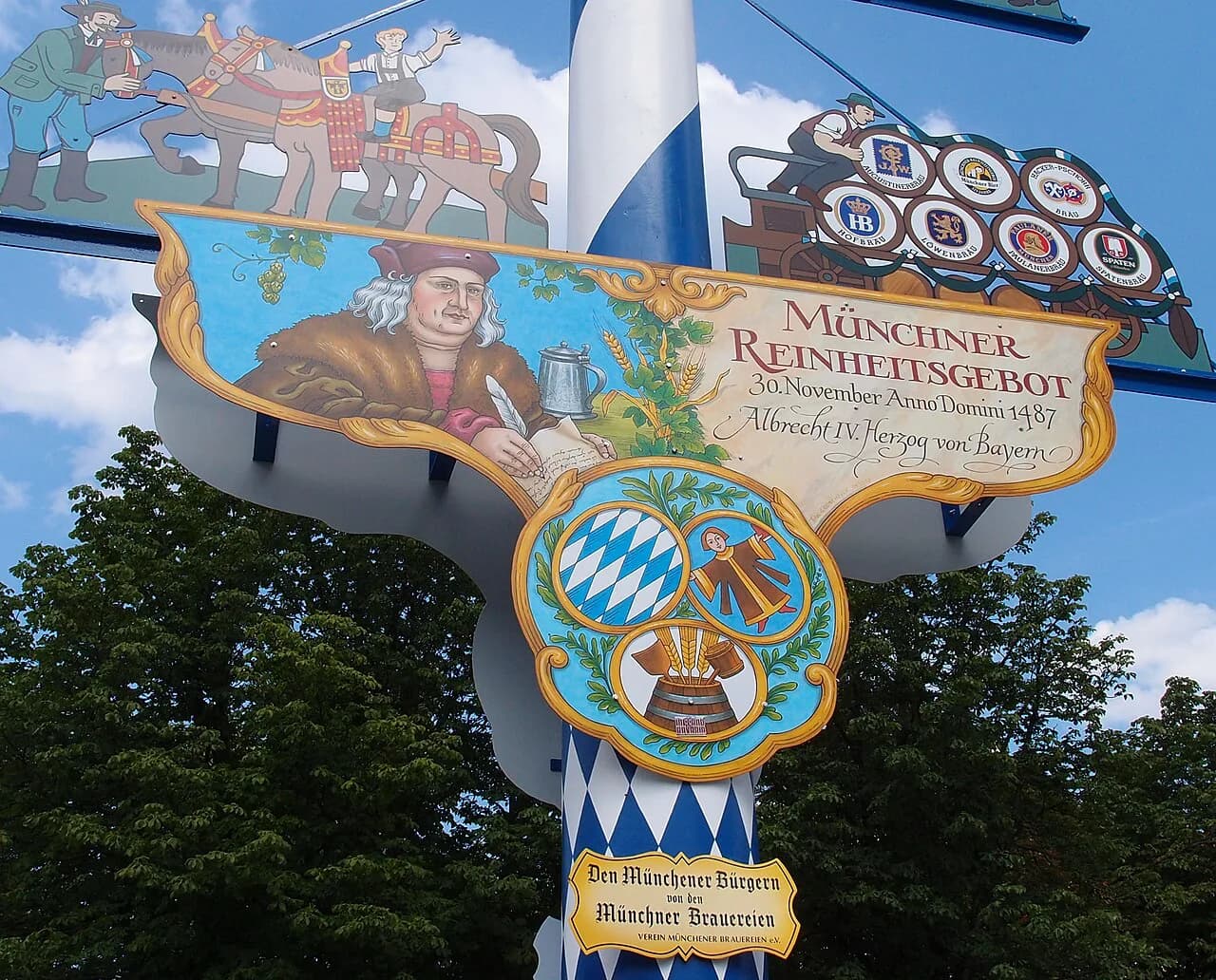
German Beer Purity Law: What It Means on a Menu in Germany
The Reinheitsgebot of 1516 limited Bavarian beer to barley, hops, and water, with yeast added later. Here is what the claim means when you order a beer.
On this page
The Reinheitsgebot is an ingredients promise: beer made under it contains only the raw materials the law names, with no artificial additives or flavor enhancers. It tells you what is in the glass, not how good it will taste, so treat it as a starting point when you read a German beer menu rather than a score.
Bavarian Dukes Wilhelm IV and Ludwig X passed the law on 23 April 1516, and it is described as the oldest food legislation in the world still in existence. This guide covers the date, the four ingredients, the bread-versus-beer reason behind barley, the missing yeast, and how the rule became German imperial law. It closes with how the claim appears on a label and what to order in a bar.
What the Reinheitsgebot Is and Why It Was Passed
The law grew out of the Landshut War of Succession at the start of the 16th century, after which the Bavarian duchies were reunited and needed standardized rules. It was part of a new state order meant to protect citizens from harmful additives, and it even regulated beer prices.
Before the law, brewers put strange things into beer, including ox gall bladders, sloes, deadly nightshade, and spruce chips. The rule was a consumer-protection measure against that kind of brewing, which is why it reads as a list of what may go in rather than a recipe.
Older regional rules existed: probably the oldest known beer instructions date from 1156 in Augsburg and threatened punishment for a brewer who made bad beer or served an unjust measure. What made 1516 different was the scale, since earlier regulations usually applied only locally.
The Date and the Four Ingredients Behind It
Keep the numbers straight and the rest of the menu makes sense. The date to remember is 23 April 1516, and the original list named barley, hops, and water; yeast joined later, in the 19th century.
When was the German Purity Law passed? Bavarian Dukes Wilhelm IV and Ludwig X passed the law on 23 April 1516. It is described as the oldest food legislation in the world still in existence, and it influenced brewing across Germany from then on.
Did the original law include yeast? No. The 1516 text named barley, hops, and water, and yeast was only added in the 19th century after a microscope made it visible.
Is wheat beer banned by the Reinheitsgebot? No. The barley-only rule was meant to keep wheat for bread, but wheat beer is not a contradiction: Weihenstephan brews a wheat beer with yeast and states plainly that it does not conflict with the law.
Those four raw materials are the whole point of the promise. The law's importance rests on a quality assurance that the beer contains exclusively the ingredients stated, a process simple enough that anyone can understand how a Bavarian beer is brewed.
Why Barley Only: Bread Versus Beer
Barley was the grain the original law named, for a practical reason: wheat was needed for baking bread, so reserving it for loaves prevented a food shortage. That single decision shaped German brewing for centuries and still explains why so much of the beer you order is barley-based.
For a traveler, this is the background to the default order in a Munich beer hall: a pale barley lager poured by the half-liter or liter. If you want the vocabulary and the drinking conventions before you sit down, our guide to Helles explains the style Germans reach for first.
Yeast Was Not in the Original Law
The 1516 text omits yeast because nobody knew yeast existed. It took a microscope to detect it, and brewers only added it to the law in the 19th century, even though it had always been part of fermentation.
That gap matters when a menu lists a cloudy, yeasty beer and you wonder whether it breaks the rule. It does not: the ingredient was simply invisible to the law until science caught up.
From Bavaria to German Imperial Law
The rule did not stay Bavarian. German imperial law in 1906 documented the Purity Law and adopted most of its regulations, which is how the idea spread beyond the Free State.
When Bavaria joined the Weimar Republic in 1918, it made sure the strict reading applied within the Free State, meaning brewing without sugar. That history explains why the Reinheitsgebot is often spoken of as Bavarian even when it is printed on a bottle sold far outside Bavaria.
Is the Reinheitsgebot Still in Force Today?
Yes, as the brewery that traces its history to this tradition puts it: the Bavarian Purity Law is still in existence and applicable today, more than five centuries after it was signed. German brewers still present it as a quality promise to drinkers at home and abroad.
Treat the 1906 and 1918 milestones above as history that explains the current rule rather than as the current text itself. What reaches your table is a brewing tradition with a long legal paper trail, not a slogan invented for tourists.
What the Law Does and Does Not Promise You as a Drinker
What it promises is ingredients: a short, checkable list and no artificial additives or flavor enhancers. What it does not promise is that you will like the beer, since a clean ingredient list says nothing about whether a Pils or a Dunkel suits your taste.
So do not read the claim as a health benefit or a purity guarantee in any medical sense. Use it to rule out a beer with added flavorings, then decide by style: a crisp Pils beer and a malty dunkel beer can both carry the same promise and still taste nothing alike.
What It Means for Wheat Beer
Wheat beer looks like a contradiction, because the original law named barley only. Weihenstephan, which brews a wheat beer with yeast, answers the puzzle directly: the two are not in conflict, because yeast was unknown in 1516 and the barley-only rule was about protecting the bread supply.
When you order a Weißbier, you are drinking a Bavarian wheat beer whose ingredients still fall within the law as it later developed. Our guide to hefeweizen covers the cloudy, yeast-forward pour you will meet in Munich and beyond.
Cologne's top-fermented Kölsch is the other style worth knowing for this conversation. If a beer menu in Cologne leads with it, our Kölsch guide explains how it is served and why the glasses stay small.
How to Spot the Claim on a Bottle or Beer-Hall Menu
Bottles and menus can carry the word Reinheitsgebot or a phrase such as “according to the Bavarian Purity Law.” Read it as a statement about ingredients, then look at the style name beside it, whether that is Helles, Pils, Dunkel, or Weißbier, to decide what you actually want to drink.
A practical order for a first round at a beer hall: a Helles if you want something clean and easy with food, a wheat beer if you want the banana-and-clove yeast character, or a dark lager if you want malt. All three sit comfortably under the same promise, so you lose nothing by choosing on taste.
If you like a stronger, maltier pour, bock beer is the seasonal option to look for, and Berliner Weisse with woodruff syrup is the tart, low-strength alternative in the capital. Both are German styles with their own serving rituals, and knowing the names makes the most of a menu that lists a dozen unfamiliar labels.
Order by Style, Not by Slogan
The Reinheitsgebot is most useful in a German bar as a quick filter for what is in the glass, not as a verdict on which beer you will enjoy. Read the style name, pick the one that matches what you want with your meal, and let the 1516 promise do its quiet background work.
Use the styles above as your shortlist, and consult the German beer overview when a menu lists something you have never heard of. That way the law stays what it is: a clear ingredient guarantee, with the choice left to you.
Explore more Germany guides
Frequently Asked Questions
When was the German Purity Law passed?
Bavarian Dukes Wilhelm IV and Ludwig X passed the law on 23 April 1516. It is described as the oldest food legislation in the world still in existence, and it influenced brewing across Germany from then on.
Did the original law include yeast?
No. The 1516 text named barley, hops, and water, and yeast was only added in the 19th century after a microscope made it visible. Brewers had always used yeast in fermentation, they simply did not know what it was.
Is wheat beer banned by the Reinheitsgebot?
No. The barley-only rule was meant to keep wheat for bread, but wheat beer is not a contradiction: Weihenstephan brews a wheat beer with yeast and states plainly that it does not conflict with the law.
Does the Reinheitsgebot tell me a beer tastes good?
It does not. The law is an ingredients promise that rules out artificial additives and flavor enhancers, but taste depends on the style, so a Pils, a Dunkel, and a Weißbier can all meet the promise and still suit different moods.
Sources
Notes for your next German food trip
Optional updates to our guides.
You might also like



Continue reading
More guides you'll find useful



