
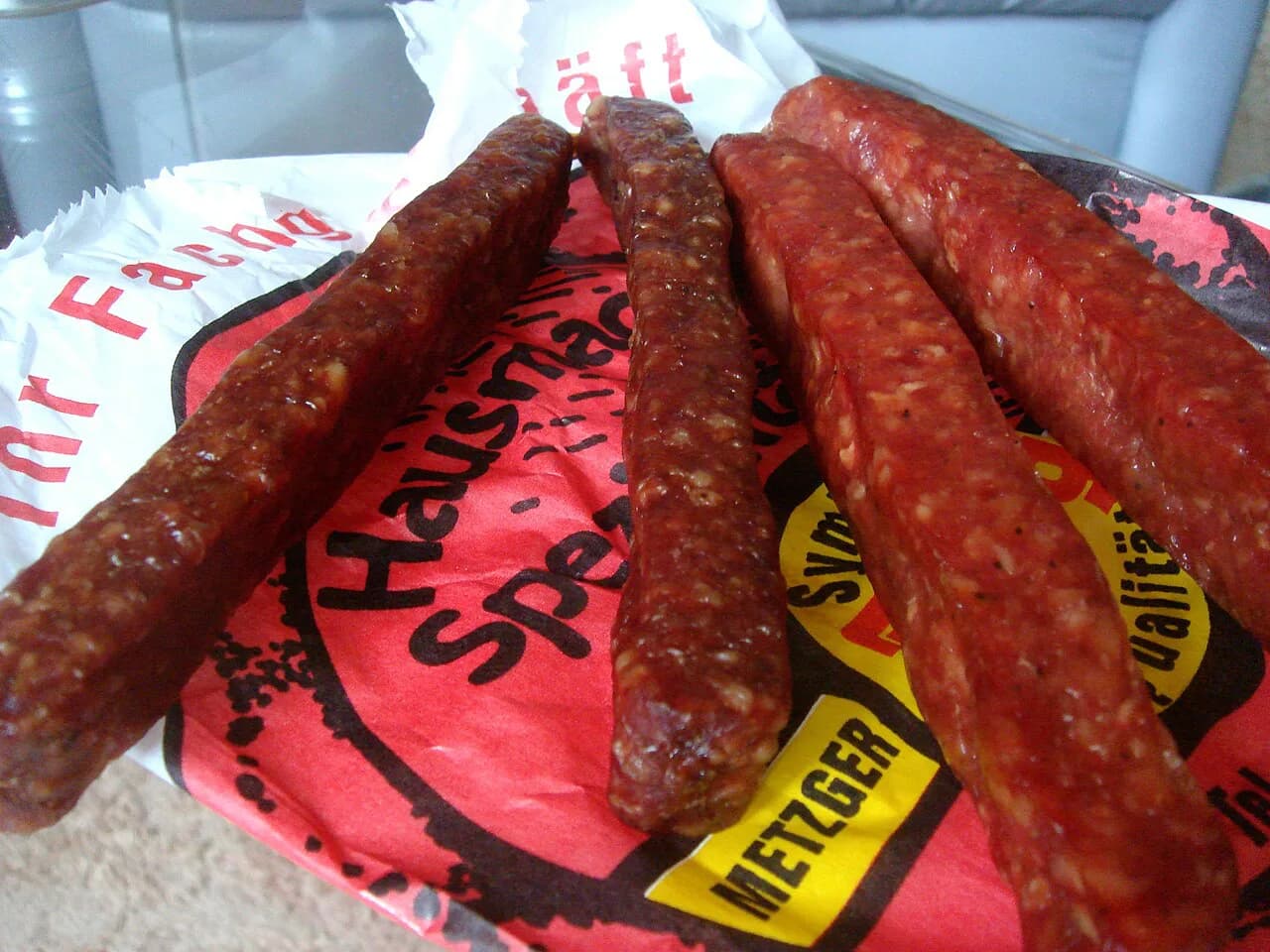
Landjäger: What This German Dried Sausage Is and How to Eat
Landjäger is a smoked, fermented, air-dried German sausage pressed into a flat stick. Here is what it tastes like and how to eat and pack it.
On this page
Landjäger is a smoked, fermented, air-dried German sausage, sold as a firm, flat stick you eat cold straight from the wrapper. It is a snack, not a restaurant dish: you buy it at a butcher counter, a market stall or a bakery and eat it on the move with bread or a beer. This guide covers the flat shape, the smoke and spice, and where Landjäger sits among the wider family of German Sausages.
Because it is cured and dried, it survives a day in a backpack better than almost anything else on a butcher's counter. That makes it the practical answer to a long train ride or a hike, and the reason it shows up in shop windows rather than on menus.
What Landjäger actually is
Landjäger belongs to the raw-sausage family: seasoned pork is stuffed, smoked, then dried until it firms up and keeps. Producers describe it as a fermented sausage, meaning the cure and the drying do the preservation work that cooking would otherwise do. That is why a Landjäger feels dense and stiff rather than springy, and why it does not need refrigeration for a normal day out.
The name has nothing to do with hunting rights. It is simply the German word for the sausage, written with an umlaut, and English speakers often flatten it to Landjaeger on packaging and menus. Either spelling points to the same dark, rectangular stick.
Why Landjäger is flat
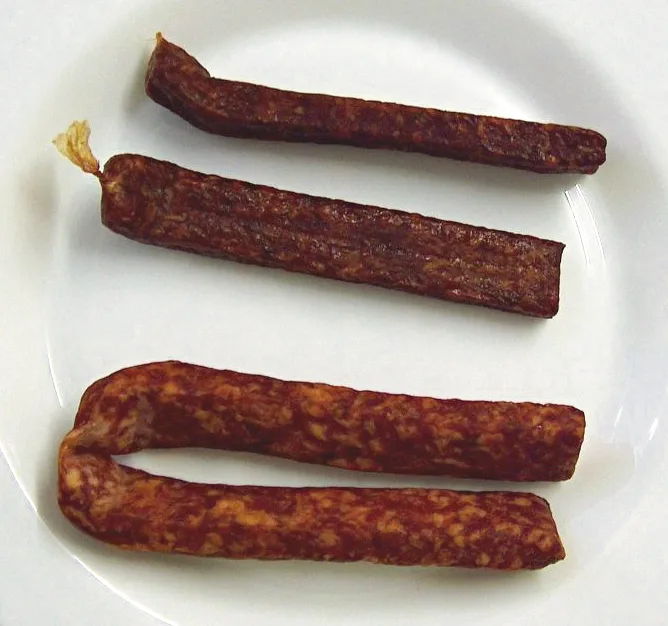
The flat shape is a production choice, not something in the spice mix. After stuffing, the sausage is pressed so the casing flattens into a thin slab, which is why you see pairs and squares rather than round links. The pressing gives it the dense, uniform body that a dried sausage needs to keep well in a bag.
Does Landjäger need to be cooked? No. Landjäger is cured, smoked and air-dried, so it is eaten as it is, cold from the wrapper or sliced onto bread.
How do you pronounce Landjäger? Say it roughly as LAND-yay-ger, with a hard g and a light, open a in the second syllable, and keep the umlaut sound close to an e. English-language packaging often drops the umlaut and writes Landjaeger, which is the same sausage.
What is a land jagger? It is a phonetic English spelling of Landjäger, the flat, smoked, dried German sausage. If you see landjager or land jaeger on a menu or a deli label, it means the same firm, dark stick rather than a fresh sausage.
That pressing step explains what you feel in the hand. A good Landjäger is rigid enough to snap when you bend it and dry enough that the cut face looks dense and uniform, which is exactly the texture you want in a sausage meant to sit in a bag all afternoon.
What Landjäger tastes like
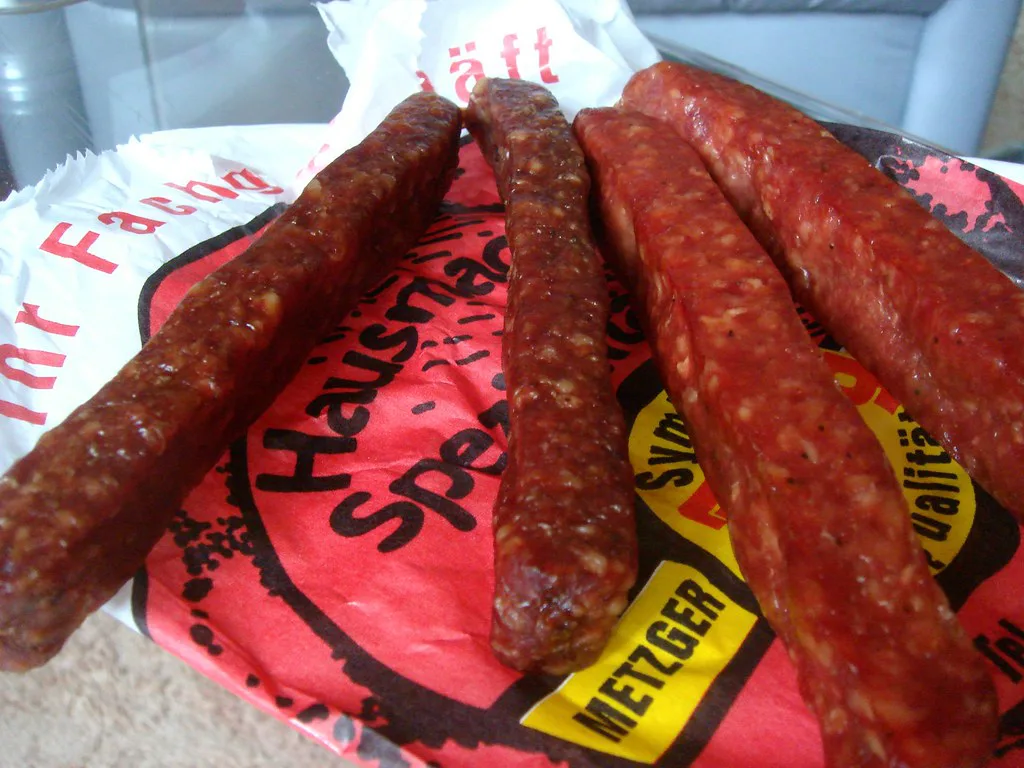
Expect smoke and salt up front, then a firm, savory bite with a spice note that leans toward pepper and garlic rather than heat. The drying concentrates the pork flavor, so a small stick delivers more intensity than a cooked Bratwurst of the same weight. Because the salt level is high, it asks for bread and something to drink rather than for eating in quantity.
The texture is the other half of the experience. It is chewy and sliceable rather than juicy, closer to a dry salami than to a soft sausage, and the casing can be tough. If you like jerky and dry-cured salami, you will recognize the appeal immediately; if you dislike a strong cured flavor, this is not the entry point into German sausage.
Where you meet it in Germany
The most common sighting is a Metzgerei, the neighborhood butcher shop, where Landjäger usually sits in a basket near the register as an impulse snack. Bakeries and small grocery counters sell single sticks the same way, often next to the pretzels and the cold cuts. Market stalls and station kiosks carry it too, which is why it turns up in the middle of a travel day rather than at a sit-down meal.
In a beer hall, Landjäger appears on cold plates alongside cheese, radishes and bread, doing the same job as a bowl of nuts: something salty to nibble while you drink. Treat it as an accompaniment rather than a main course, and you will use it the way Germans do.
How to eat Landjäger
Peel the casing if it is thick and papery; leave it on if it is thin and clings tightly, since the skin holds the stick together when you bite. Most people either slice it into thin coins or bite off pieces, and both work. Slicing makes it go further and lets you share a stick on a picnic bench, while biting straight in is what you do on a platform with a train to catch.
Bread, mustard and a beer are the classic companions. A slice on rye with a sharp mustard balances the salt and smoke, and a clean lager or a Pils keeps the palate from getting weighed down. If you are building a snack plate, add a pickled cucumber or radishes for acidity, and keep the portions small; one stick per person is usually plenty.
Landjäger also works as a flavoring rather than a snack. Sliced thin and added to a lentil or potato pot, it seasons the dish the way bacon would, which is a useful trick in a rental apartment with one pan.
Landjäger vs. other German sausages
The closest relatives are the other raw and dried sausages: salami-style sticks and spreadable raw sausages such as Teewurst, which is soft enough to spread on bread. Landjäger is the firm, portable end of that family, while a Bratwurst is fresh, cooked before eating and eaten hot. Knowing which side of that line a sausage sits on prevents the classic mistake of biting into a raw sausage that was meant to be grilled.
Ordering gets easier once you can name the styles. Weißwurst is a pale Munich sausage eaten warm with sweet mustard, a Bockwurst is a plump cooked sausage often served with mustard, and a Knockwurst is a short, snappy cooked link. The Thüringer Rostbratwurst and Nürnberger Rostbratwurst are grilled sausages, not dried ones, so they belong in a different mental category when you read a menu.
The same logic separates the spreads and the cooked links at a cold counter. Liverwurst is a spreadable sausage for rye bread, Blutwurst is a blood sausage eaten sliced or fried, and a frankfurter is the smooth cooked sausage that became the hot dog. Landjäger has no cooking step at all, which is the single most useful thing to remember about it.
How Landjäger is made
Making Landjäger at home is a project for people already comfortable with curing salts and drying, not a first sausage attempt. Hobby recipes describe a mix of pork, a cure, and a smoke-and-dry phase before the sausage is firm enough to finish. The drying conditions matter more than the spice list, because a warm, humid room spoils the batch.
For a traveler, the practical takeaway is that firmness and deep color are signs of a proper drying period, not of a higher grade of meat. A stick that feels soft in the middle has not finished drying, and one that is rock-hard has probably dried too long.
Buying it to take home
Landjäger is one of the easiest German foods to carry across a border, because it is sold shelf-stable and vacuum-sealed or simply wrapped in paper. Buy whole sticks rather than slices, keep them in a paper bag rather than a sealed plastic container so they can breathe, and pack them in your checked bag if you are crossing into a country with strict rules on meat products. Customs rules on pork imports change, so confirm the current rule for your route before you buy a large quantity.
At the counter, ask for the sticks rather than the sliced cold cuts, and check the cut end for an even, dense color. If you only have a day in Germany, a Landjäger from a station bakery is a better travel snack than a pastry that will crush in your bag.
Is Landjäger worth trying?
Yes, if you want a portable, intensely savory snack that shows you a different side of German sausage culture than the grilled bratwurst. Buy one stick from a butcher or bakery counter, slice it with bread and a little mustard, and you have the cheapest and most transportable taste of the country.
Skip it if you dislike salty, cured flavors or a chewy bite; a warm Weißwurst or a grilled Thüringer is a friendlier first step. Either way, order at the counter by name, and you will get the flat, dark stick rather than a cooked link.
Explore more Germany guides
Frequently Asked Questions
Does Landjäger need to be cooked?
No. Landjäger is cured, smoked and air-dried, so it is eaten as it is, cold from the wrapper or sliced onto bread. It is preserved by fermentation and drying rather than by heat, which is why the stick is firm and stable for a normal travel day.
How do you pronounce Landjäger?
Say it roughly as LAND-yay-ger, with a hard g and a light, open a in the second syllable, and keep the umlaut sound close to an e. English-language packaging often drops the umlaut and writes Landjaeger, which is the same sausage.
What is a land jagger?
It is a phonetic English spelling of Landjäger, the flat, smoked, dried German sausage. If you see landjager or land jaeger on a menu or a deli label, it means the same firm, dark stick rather than a fresh sausage.
Is Landjäger the same as salami?
They are close cousins, since both are cured and dried, but Landjäger is pressed flat and usually carries a stronger smoke and spice profile. Salami is typically round and often aged longer, while Landjäger is built as a portable snack.
Sources
Notes for your next German food trip
Optional updates to our guides.
You might also like



Continue reading
More guides you'll find useful




