
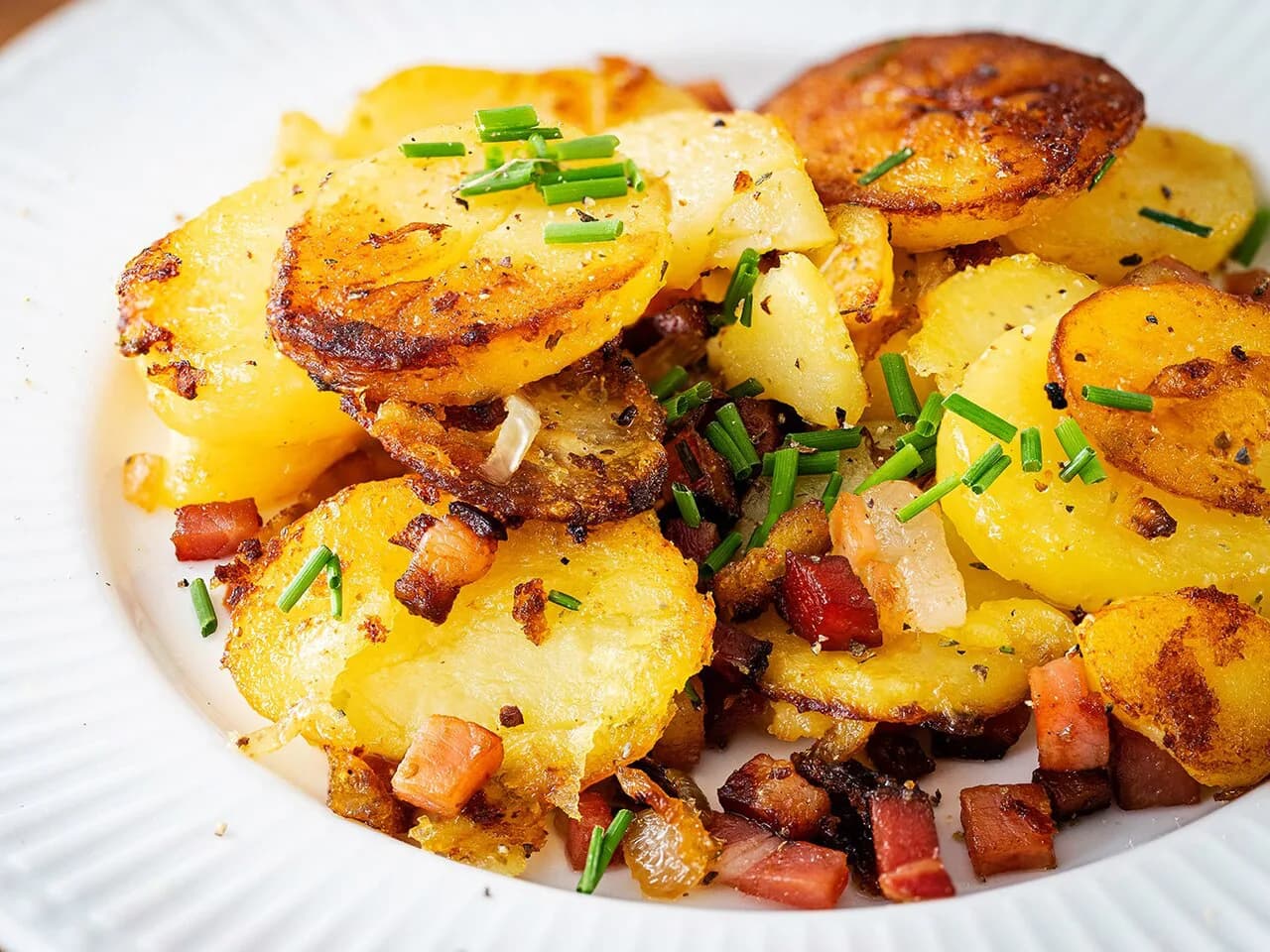
Bratkartoffeln: Germany's Fried Potatoes Guide
Bratkartoffeln are crispy pan-fried potatoes with onions, sometimes bacon, and marjoram. Here is what they are, what to order with them, and how to cook them.
On this page
Bratkartoffeln are German fried potatoes: boiled potatoes sliced and pan-fried with onions until the edges go crusty and golden. They show up on German menus as a side to schnitzel, sausage and roast meat, and at home they are the classic way to use up yesterday's boiled potatoes. This guide covers what the dish is, which potatoes to buy, the frying order that decides whether the slices crisp or collapse, the bacon question, and what Germans order alongside them.
What Bratkartoffeln are
Boiled potatoes are cut into slices, fried in oil until browned on both sides, and finished with onions, salt, pepper and herbs. It is a plain dish built on technique rather than on a long ingredient list, which is why the details matter more than the recipe. The dish belongs with the wider family of German sides, which run from dumplings and red cabbage to sauerkraut and potato salad.
At its simplest, Bratkartoffeln is potatoes, fat, onion and seasoning, and home recipes vary in how much they add beyond that. One common version adds bacon, paprika and parsley and treats the potato, onion and bacon trio as the heart of the dish. The name translates plainly as fried potatoes, so do not expect a cream sauce or a casserole underneath.
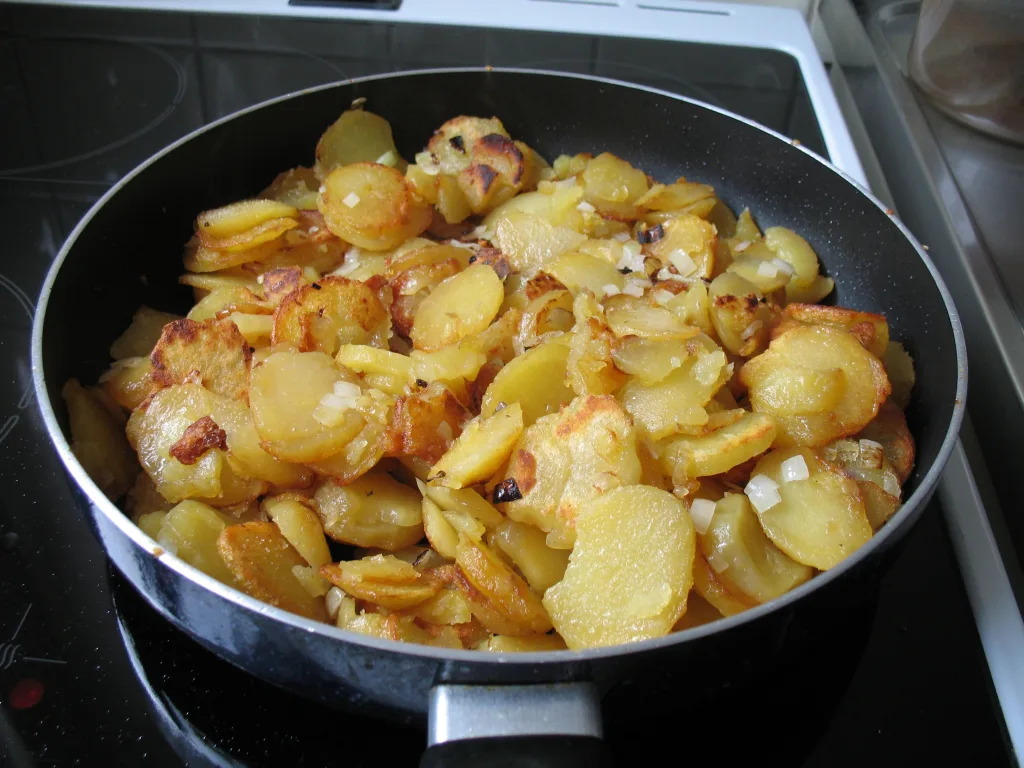
Why day-old boiled potatoes work best
Cooling firms up boiled potatoes, so they slice cleanly and hold their shape in the pan instead of smearing. Cook them a day ahead, drain, peel once cool, and keep them covered in the fridge overnight; that is the single step that separates crisp slices from a soggy pile. If you are cooking potatoes for this dish on the same day, let them cool completely before slicing.
Why day-old boiled potatoes work best. Cooling firms up boiled potatoes, so they slice cleanly and hold their shape in the pan instead of smearing.
The flavor base: onions, marjoram and butter at the end. Marjoram is the aroma that makes Bratkartoffeln taste German rather than generically fried.
Bacon or not: the two common versions. Bacon, or Speck in German, turns Bratkartoffeln from a side into something closer to a main dish.
The variety matters as much as the timing. Waxy potatoes keep their shape after boiling and turn crisp in the pan, while mainly waxy ones are a slightly softer but workable second choice; floury potatoes break apart and are better saved for mash or dumplings. German supermarkets mark this on the bag with a color code, so look for the green or red label rather than guessing from the name.
Slice about three to four millimeters thick, roughly an eighth of an inch. Thinner slices soften before they brown, and thicker ones need so long in the pan that the onions burn first. The same waxy potatoes that work here are also the base for German potato salad, another dish where the potato variety decides the result.
The flavor base: onions, marjoram and butter at the end
Marjoram is the aroma that makes Bratkartoffeln taste German rather than generically fried. Toast dried marjoram briefly in the last minutes of cooking to wake it up, then season with salt, black pepper and a pinch of cayenne for heat. Parsley, thyme, caraway and freshly grated nutmeg are all classic additions, with fresh herbs going in just before serving so they keep their color.
Fry the potato slices in oil first, add the onion strips for the last few minutes so they caramelize without burning, and add butter only at the end in a pan pulled off the heat. Butter burns at high temperatures and turns bitter, so tossing the finished potatoes in a knob of foaming butter gives you the buttery taste without the scorched edge. Red onions are a good choice because they soften quickly and sweeten as they color.
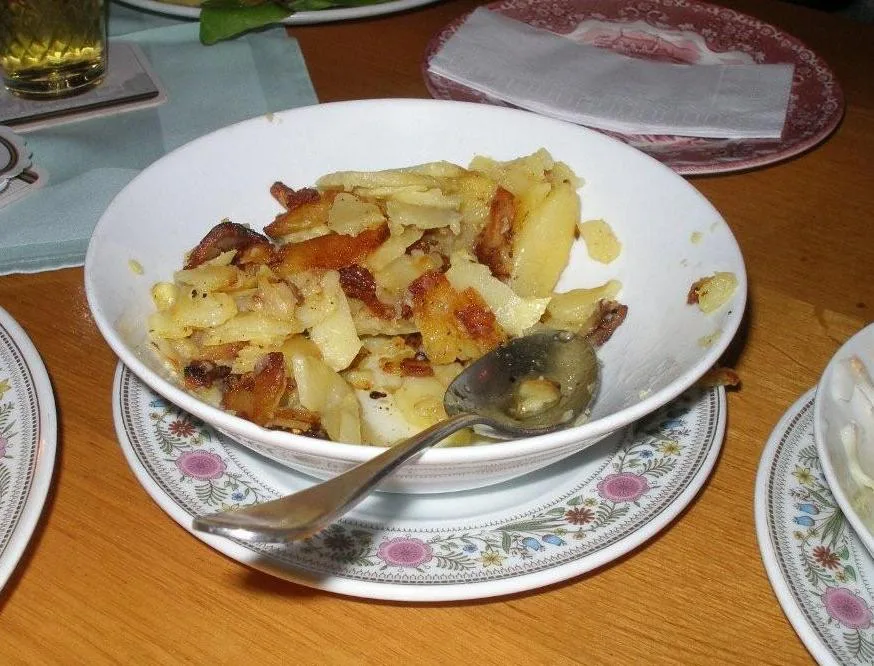
Bacon or not: the two common versions
Bacon, or Speck in German, turns Bratkartoffeln from a side into something closer to a main dish. Cook the diced bacon first, lift it out, fry the onions in the rendered fat, then return the bacon at the end so it stays crisp instead of stewing with the potatoes. The trade-off is salt: bacon brings plenty, so hold back on the salt you add and taste before the final seasoning.
Without bacon, the dish is lighter and more versatile, and it fits next to a rich roast or a creamy sauce that would otherwise be too much. Some cooks use both bacon and onion, others keep it vegetarian with onion alone and rely on marjoram and nutmeg for depth. Pick based on what else is on the plate, not on which version is more authentic.
How Bratkartoffeln are served in Germany
In a German restaurant, Bratkartoffeln most often arrive as the side to a schnitzel, a pork roast or a sausage, taking the place that fries or mashed potatoes might occupy elsewhere. They also appear as a standalone dish topped with a fried egg, which makes a cheap, filling plate at lunchtime. Because the potatoes are already rich, a sharp accompaniment cuts through them nicely.
Matjes herring, the mild young herring sold in northern Germany, is another classic partner and gives the plate a briny contrast to the buttery potatoes. Neither pairing is a rule, so order what looks good on the menu rather than waiting for a prescribed combination. Both versions keep the potatoes in the foreground, which is the point of the dish.
When you are building a plate of German food, think about what the potatoes are replacing: dumplings, Spätzle or bread. If the main course is already starchy, add sauerkraut, a green salad or a vegetable instead of a second potato dish.
Step by step: the pan method
Cut the cold boiled potatoes into slices, heat a generous film of oil in a wide pan over medium-high heat, and lay the slices in a single layer. Leave them alone for three to five minutes until the underside is golden, then turn and brown the other side; stirring early is what turns the slices into broken, pale pieces. If the pan is too small, work in two batches rather than piling them up.
Add the onion strips toward the end, season with salt, pepper and marjoram, and toss with butter off the heat. A non-stick or well-seasoned cast-iron pan gives the best crust with the least sticking, and patience at the start is the difference between browned slices and a mushy scramble.
Oven and mushroom variations for a bigger batch
For a crowd, parboil and slice the potatoes ahead, then spread them on a tray with oil and roast at high heat, adding the onions partway through. Finish with butter and marjoram as you would in the pan. A deep fryer works too: fry raw or boiled slices briefly in hot oil, keeping them apart so they do not stick, then finish them in a pan with butter and herbs.
Mushrooms are a seasonal addition, folded in near the end so they keep their texture rather than releasing water and steaming the potatoes. Either way, keep the pan or tray uncrowded, since moisture is the enemy of a crust.
Common mistakes and what to order instead
The usual failures come down to four things: floury potatoes that fall apart, a crowded pan that steams instead of fries, butter added at the start so it burns, and stirring too soon before a crust forms. Fix those and the dish is nearly foolproof. A typical version comes in around 290 calories per serving, which reflects the oil and butter more than the potatoes themselves, so treat it as a rough figure rather than a fixed number.
If you want a different potato dish, German potato pancakes are grated and fried into crisp rounds, often served with applesauce or a savory topping. German dumplings, whether the Thüringer Klöße style or Bavarian versions, are the starchy alternative to potatoes when the main course calls for something to soak up gravy.
Which version should you cook first?
Start with the plain version: day-old waxy potatoes, oil, onions added late, marjoram, salt and pepper, and butter off the heat. Get that crust right once and the bacon version, the mushroom variation and the oven batch all follow easily.
Serve it beside a schnitzel or a fried egg and you have the version Germans actually eat at home, not a restaurant approximation.
Explore more Germany guides
Sources
Notes for your next German food trip
Optional updates to our guides.
You might also like



Continue reading
More guides you'll find useful





