

Currywurst: Germany's Sausage Snack, Explained
Currywurst is sliced sausage in curried tomato sauce, a German street-food staple. Here is what it is, where it came from and how to order it.
On this page
Currywurst is a hot sausage, sliced into coins, drowned in a curried tomato sauce and handed over in a fluted paper tray with a small fork or a wooden pick. It is the snack Germans reach for between shopping and dinner, and it costs less than a sit-down meal at almost any stand.
The sausage itself is usually a bratwurst, though some stands use a boiled sausage, and the sauce is a cooked tomato base sharpened with vinegar, sweetened with sugar and seasoned with curry powder and paprika. This guide covers how it is served, the Berlin origin story and its rivals, the ordering vocabulary and how the sauce is built at home, and it sits alongside the wider world of German street food that runs from Döner kebab to Flammkuchen.
What currywurst is
The dish is two parts: a pork sausage and a sauce. The sausage is grilled, fried or simmered, then cut into thick slices so the sauce reaches every piece. The sauce is a simmered tomato mixture—passata or ketchup as the base—with curry powder, paprika, sugar, vinegar and often a little mustard or Worcestershire sauce for depth. It is served hot, and the sauce is ladled over rather than served on the side.
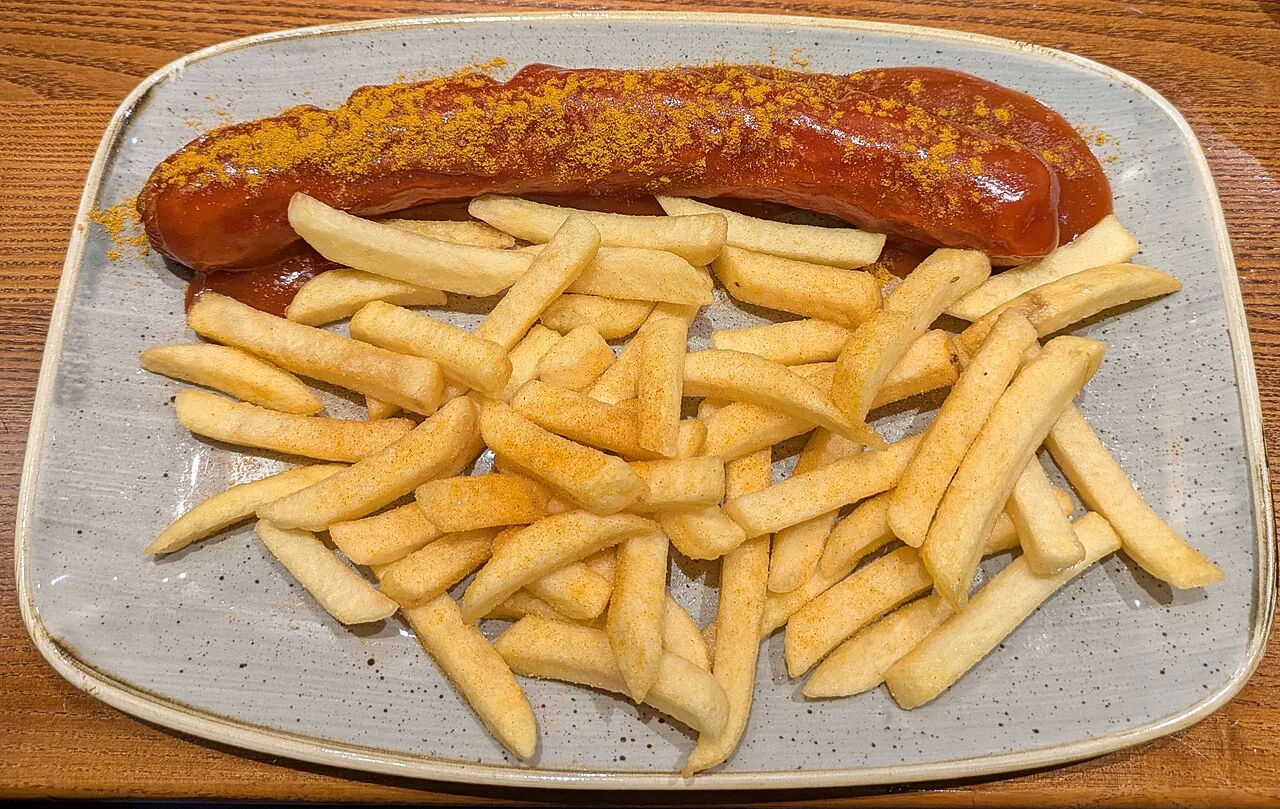
How it is served and eaten
At a stand, currywurst arrives in a shallow paper tray, already sliced and sauced, with a small fork stuck in or a wooden pick on the side. You eat it standing up or on a ledge, often with a bread roll to mop the sauce or a portion of fries alongside. The whole thing is finger food in spirit even if a fork does the work, so expect no ceremony and no plate.
What does currywurst mean? Currywurst translates literally as curry sausage: a sausage sliced and covered in a curried tomato sauce. The name describes the dish rather than a specific recipe, which is why the sauce varies from stand to stand and city to city.
Is currywurst a bratwurst? Often, yes—many stands use a bratwurst, a pork sausage made for grilling or frying. Some use a boiled sausage instead, which gives a softer texture.
How do I order currywurst without the skin? Say ohne Darm, which means without the casing. If you want the skin left on for the snap, say mit Darm.
Portions vary by stand: some sell one sausage, others a pair, and the sauce-to-meat ratio is a matter of local pride. If you want more sauce, ask for extra Sauce, and if you want it hotter, say scharf (spicy).

The Berlin origin story: Herta Heuwer, ketchup and curry powder
The most-cited version of the story puts the first currywurst in Berlin in 1949, when Herta Heuwer traded with British soldiers for ketchup and curry powder, mixed them with peppers and paprika, and poured the result over a fried, sliced boiled sausage. Her stand took off, and she later opened a permanent snack bar on Kantstraße. In 1959 she patented her sauce under the name Chillup, which is the strongest piece of paper in the argument.
She never shared the recipe, and the sauce as she made it died with her in 1999. Every stand since has built its own version, which is why two currywursts in the same city can taste nothing alike.
The rival claims from Hamburg and the Ruhr
Berlin does not have the field to itself. There are claims that a Hamburg street vendor was dishing up curried sausage years earlier, and Uwe Timm's novel The Invention of Curried Sausage builds a fictional version of that claim—though Timm has said the story has roots in fact. The Ruhr region has entered with its own argument: that the snack depends on ketchup arriving with American GIs.
The patent gives Berlin the stronger case, but the dispute is not settled and Germans enjoy arguing about it. Treat the origin story as a story rather than a verdict, and you will get more out of it.
The sauce recipe is not one recipe: sweet, spicy and regional variations
The sauce is a personal and local recipe rather than a fixed one. Some versions are sweeter, some spicier, and every vendor puts their own spin on it. None of these is wrong; they are local dialects of the same dish.
At the counter, scharf means spicy and extra Sauce means more of it. If you want to taste the sausage rather than the sauce, ask for the sauce on the side.
How to order it: mit oder ohne Darm, extra sauce, and the words to use
The key question is mit oder ohne Darm—with or without casing. Mit Darm means the sausage is served in its skin, which gives a snap when you bite; ohne Darm means the skin is removed, leaving a softer bite. Neither is better, and the vendor will not judge either way.
A short vocabulary gets you through the queue: eine Currywurst, bitte (one currywurst, please), mit Darm or ohne Darm, scharf (spicy) or nicht scharf (not spicy), and extra Sauce for more sauce. Have cash ready, since many stands are cash-only.
What to eat with it: bread roll, fries, or nothing
A Brötchen—a plain bread roll—is the classic side, because it soaks up the sauce and costs little. Pommes frites (fries) turn the snack into a meal and are the usual order at a stand with a fryer. A third option is nothing at all: eat it standing, then move on.
On the drink side, a small beer or a soft drink is the normal pairing at a stand, and portions are modest, so one round is usually the point rather than the start of a long session.
Where to eat currywurst across Germany, not only in Berlin
Currywurst is sold across the country, from dedicated currywurst stands to imbisses (snack counters) that also fry up fries and sausages. Berlin is the dish's most famous home. In most German cities you will find a stand within a few minutes of the main station or the central shopping street, and many travelers work it into a day of trying German sausages.
The best signal is a queue at lunchtime and a short menu: a stand selling currywurst, fries and little else is usually doing the dish well. If you are building a food day, treat currywurst as one stop among several—it is a snack, not a destination meal, and it leaves room for the next one.
Currywurst at home: the sauce ingredients that matter
A home version is mostly about the sauce. Start with a tomato base—passata or ketchup—and add curry powder, sweet smoked paprika, brown sugar, a little balsamic vinegar, mustard and Worcestershire sauce, then simmer it until it thickens. The sweetness and the acid are what make it taste like currywurst rather than plain tomato sauce, so taste and adjust both as you go.
Cook the sausages first, slice them thick, and spoon the sauce over at the end so the skin stays crisp. A bread roll and a few fries complete the plate, and the sauce keeps well in the fridge for a second round.
Which currywurst to order first
For a first currywurst, order it mit Darm and nicht scharf at a busy stand, with a Brötchen on the side. That gives you the snap of the skin, the sweet-tangy Berlin-style sauce and something to soak it up, without committing to heat you did not ask for.
If you are in Hamburg or the Ruhr, order the local version and expect a different sauce—that comparison is half the fun. Either way, eat it standing, pay in cash, and save your appetite for the next stop.
Explore more Germany guides
Frequently Asked Questions
What does currywurst mean?
Currywurst translates literally as curry sausage: a sausage sliced and covered in a curried tomato sauce. The name describes the dish rather than a specific recipe, which is why the sauce varies from stand to stand and city to city.
Is currywurst a bratwurst?
Often, yes—many stands use a bratwurst, a pork sausage made for grilling or frying. Some use a boiled sausage instead, which gives a softer texture. The sauce, not the sausage type, is what makes it a currywurst.
How do I order currywurst without the skin?
Say ohne Darm, which means without the casing. If you want the skin left on for the snap, say mit Darm. Both are standard requests and staff will understand immediately.
Sources
Notes for your next German food trip
Optional updates to our guides.
You might also like



Continue reading
More guides you'll find useful





