
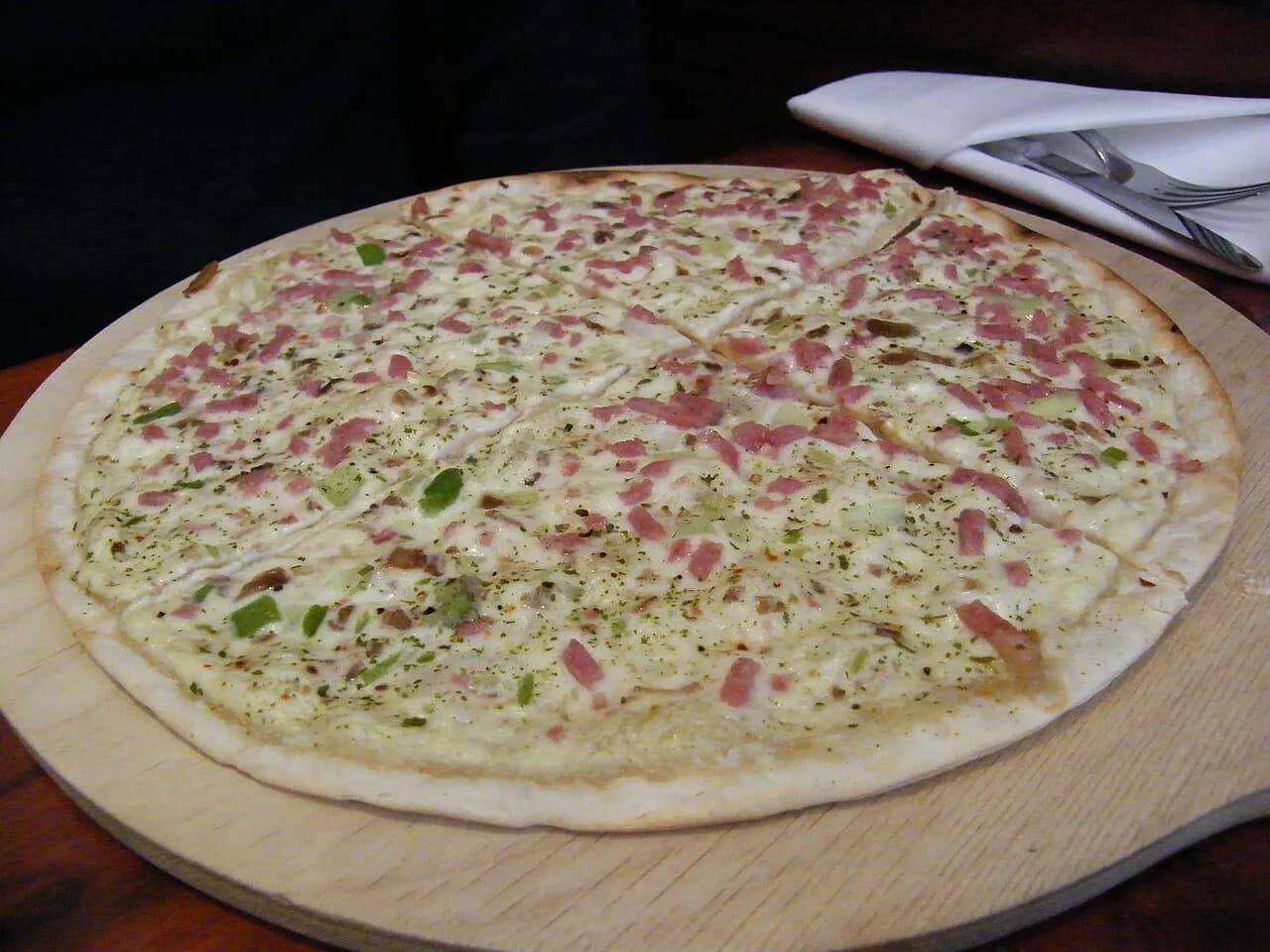
Germany Flammkuchen Guide: What to Order and Where
Flammkuchen is a thin, yeast-free flatbread from the Alsace borderlands, topped with crème fraîche, onion and bacon. Here is what to order and how it is served.
On this page
Flammkuchen is a very thin, yeast-free flatbread baked hot and fast and topped with a creamy base, thinly sliced onion and bacon. The name is Alsatian for "flamed cake," which is why the same dish appears on French menus as tarte flambée. This guide covers what the dough is, where the dish comes from, what the classic version tastes like, how it differs from pizza, and how to order one in Germany.
The short version for a first order: take the classic, split it with the table, and drink something cold and light alongside. Everything else on the menu is a variation on that.
What Flammkuchen is: a thin, yeast-free flatbread baked hot and fast
The dough is flour, salt, water and a little oil, with no yeast and no rising time. Bread flour is the usual choice because its higher protein content lets the dough be rolled out very thin without tearing, and helps it crisp. Because the base is so thin, it bakes in just a few minutes at high heat, the way it was originally made in wood-fired ovens.
That speed is the point of the dish. It arrives crisp at the edge and soft enough to fold in the middle, and it is meant to be eaten right away rather than set aside. If you order more than one, expect them to come out of the kitchen one after another rather than all at once.
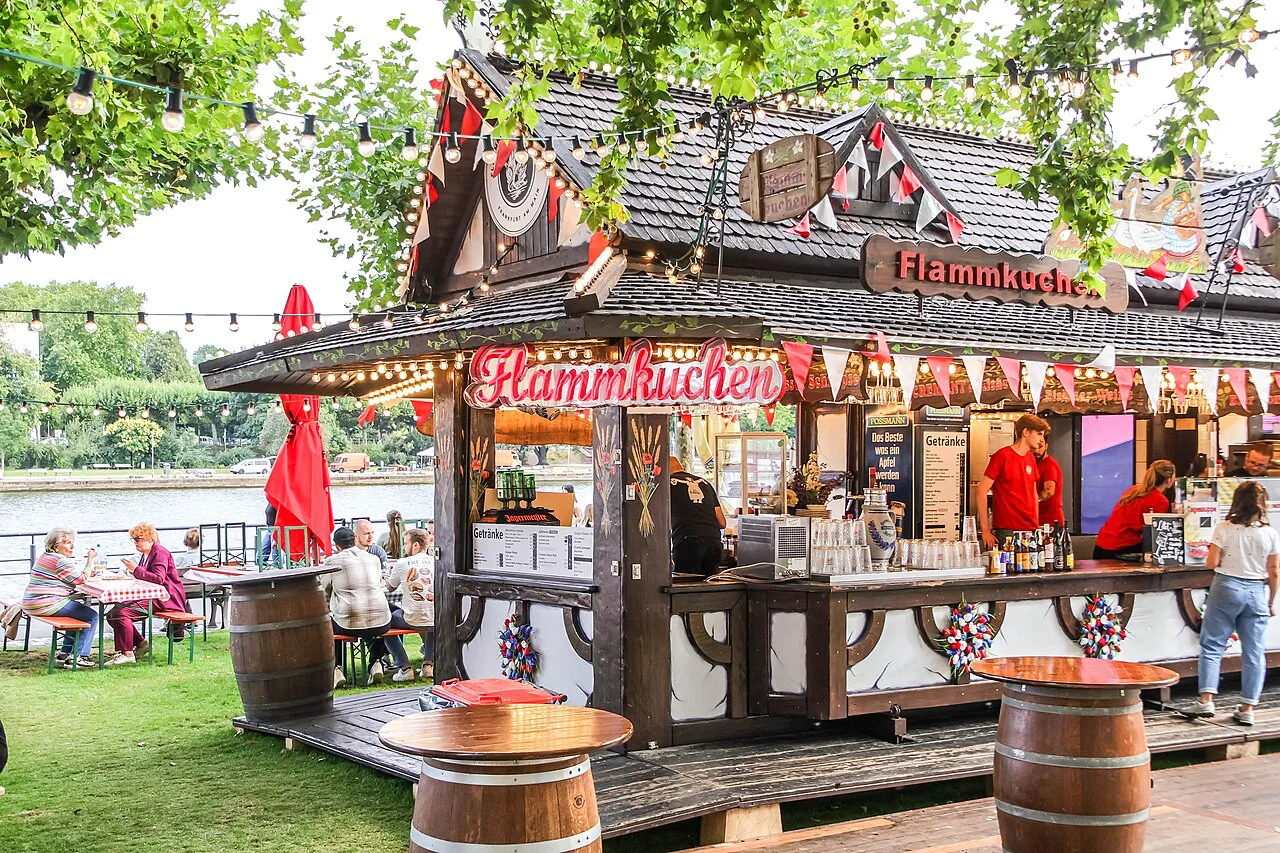
Where the name comes from: Alsatian for "flamed cake"
The name comes from the Alsatian dialect and translates as "flamed cake," a reference to the fierce heat of the oven it was baked in. The French name, tarte flambée, carries the same idea. In Alsatian pronunciation the dish is often written Flammekueche, which is the form you may see near the French border.
How do you pronounce Flammkuchen? Say it in three parts: FLAM-koo-ken, with a short a and a hard k. The Alsatian name Flammekueche is the form you will see printed on menus near the French border.
Is Flammkuchen served with a sauce on top? There is no tomato sauce. The base is a thin layer of crème fraîche or sour cream, usually seasoned with nutmeg before the onion and bacon go on.
Can you get a vegetarian Flammkuchen? Yes. Mushroom versions replace the bacon and keep the same creamy base, and cheese-topped variations are also common.
The story behind it is practical: farmers in the region used a thin sheet of dough to test whether the wood-fired oven was hot enough for bread. If the test piece baked through in minutes, the oven was ready, and it became a dish in its own right.
German or French? The Alsace borderland origin story
Flammkuchen comes from Alsace, the region along the border between France and Germany that has changed hands between the two countries over the centuries. That history is why the dish reads as both French and German, and why you find it on menus on either side of the Rhine.
In Germany it turns up most reliably in Baden and the Palatinate, the regions closest to Alsace. Elsewhere it appears as a seasonal or specialty item rather than a staple, so it is worth scanning the menu for it when you are in the southwest. Treat it as a regional dish that travels, not a national one.
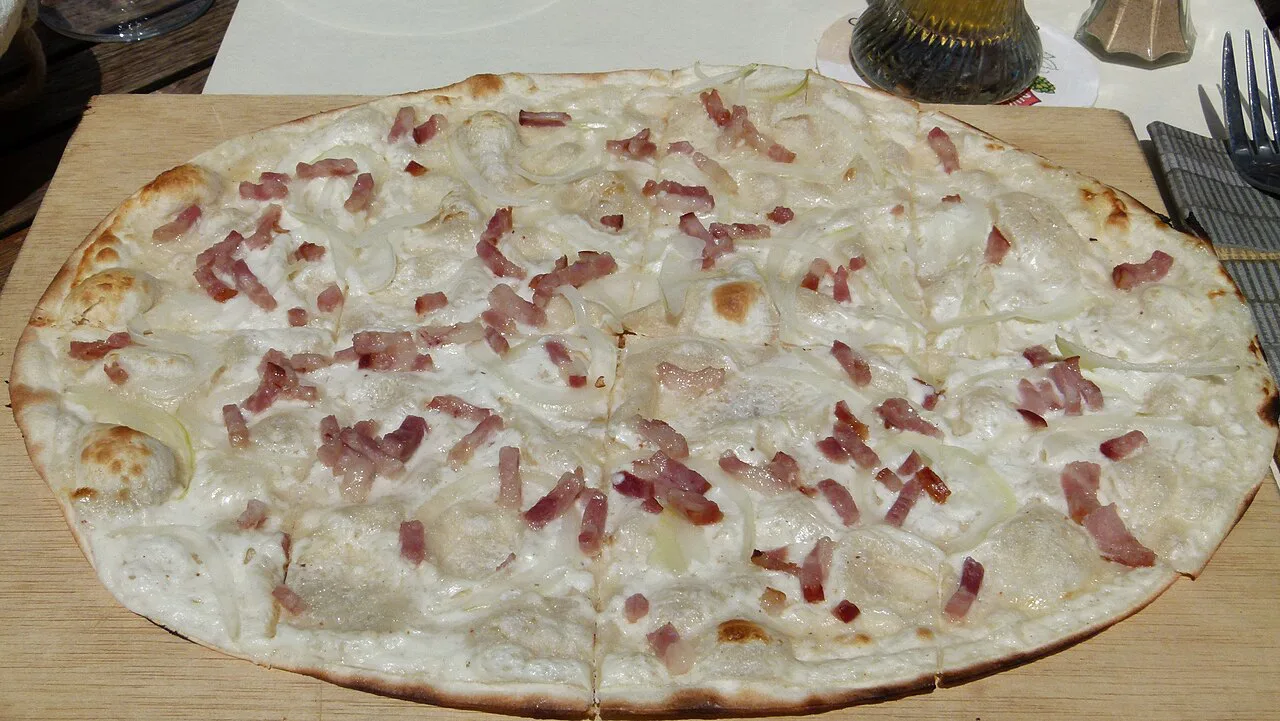
The classic topping: crème fraîche, onion and bacon
The standard version is spread with crème fraîche or sour cream, seasoned with nutmeg, then topped with thinly sliced onion and bacon lardons before baking. The onion is sliced thin on purpose: thick slices release too much moisture and leave the middle of the flatbread soggy.
Nutmeg goes on the base before the cream is spread, so the flavor melds into the topping as it bakes. Some versions finish with black pepper or a scatter of green onion. The overall effect is rich and sharp at once.
Variations you will see: vegetarian, mushroom and cheese
Vegetarian versions swap the bacon for sautéed mushrooms, keeping the same crème fraîche base and nutmeg. Cheese-topped versions exist too, and they edge the dish closer to a pizza in richness.
Beyond that, toppings follow the kitchen's imagination rather than a fixed list. If a version you are considering sounds heavy, remember the base is thin and the portion is meant for sharing, so richness spreads out across the table.
Flammkuchen vs. pizza: dough, sauce, thickness and how it is baked
The difference starts with the dough. Pizza dough is yeast-leavened and rested, and it puffs into a rim; Flammkuchen dough has no yeast, is rolled out extremely thin, and stays flat. The sauce is the second break: instead of tomato, you get a thin layer of crème fraîche or sour cream.
The bake is short and hot, closer to a blast than a long oven stint, which is why the edges crisp before the center dries out. The result is lighter than a pizza of the same size, and it is eaten with a knife and fork or folded by hand rather than treated as a slice to pick up.
How it is served in Germany: whole, shared, and cut at the table
In Germany a Flammkuchen usually arrives whole, on a board or a paddle, and the table cuts it themselves. It is a social dish: one per person is a full meal for some appetites and too much for others, so splitting two or three among a group is common. As a starter, one flatbread stretched across four people works well.
If you are eating alone, order one and expect a generous plate. In the southwest it is also a fixture of a casual evening meal, the kind of place where a group orders a round of them and a round of drinks and stays a while.
What to drink with it: a cold beer or a local white
The classic pairing is a cold, light beer, which cuts through the cream and the bacon. A crisp local white wine works on the same principle. The point is contrast: something cold and clean against a rich, salty topping.
Keep the pace moderate, especially if you are ordering several flatbreads across an evening. A small beer alongside a shared Flammkuchen is a sensible frame, and it leaves room for the next course if the table is still hungry.
Eating it in Baden and the Palatinate: what to expect
In the southwest, Flammkuchen is a dish to seek out in the regions closest to Alsace, where its borderland origin is at home. Portions are built for sharing, and the pace of these meals tends to be unhurried.
Elsewhere in Germany, treat it as a specialty to look for rather than a given. It sits comfortably alongside other handheld and shareable German food, from Leberkäse to the wider German street food you find in city centers. If you are planning a meal around it, the dish is the destination; the venue is secondary.
Ordering and paying: portions, sharing and splitting the bill
Order by the flatbread, not by the slice, and ask how large the portion is if the menu is not clear. For a group, a simple rule is one flatbread for every two people as a starter, or one each if it is the main event. Ask for the classic first so the table knows the baseline before trying variations.
Splitting the bill is normal in Germany, but say so when you ask for it rather than at the last moment. Many places take cards, many smaller ones still prefer cash, so carry some euros. If you want a single flatbread to share as a first course, order it as a starter so the table can pace the meal.
Which Flammkuchen should you order first?
Order the classic first: crème fraîche, thin onion and bacon, with nutmeg in the base. It is the version the dish was built around, and it tells you whether you want a second one and in which direction, mushroom or cheese or something else.
Then decide on quantity: one to share as a starter, or one each as a meal. Pair it with something cold and light, keep the table moving, and you have the dish the way it is meant to be eaten in Baden and the Palatinate.
Explore more Germany guides
Frequently Asked Questions
How do you pronounce Flammkuchen?
Say it in three parts: FLAM-koo-ken, with a short a and a hard k. The Alsatian name Flammekueche is the form you will see printed on menus near the French border.
Is Flammkuchen served with a sauce on top?
There is no tomato sauce. The base is a thin layer of crème fraîche or sour cream, usually seasoned with nutmeg before the onion and bacon go on.
Can you get a vegetarian Flammkuchen?
Yes. Mushroom versions replace the bacon and keep the same creamy base, and cheese-topped variations are also common. Ask what the kitchen is doing that day, as the options vary.
Sources
Notes for your next German food trip
Optional updates to our guides.
You might also like



Continue reading
More guides you'll find useful





