
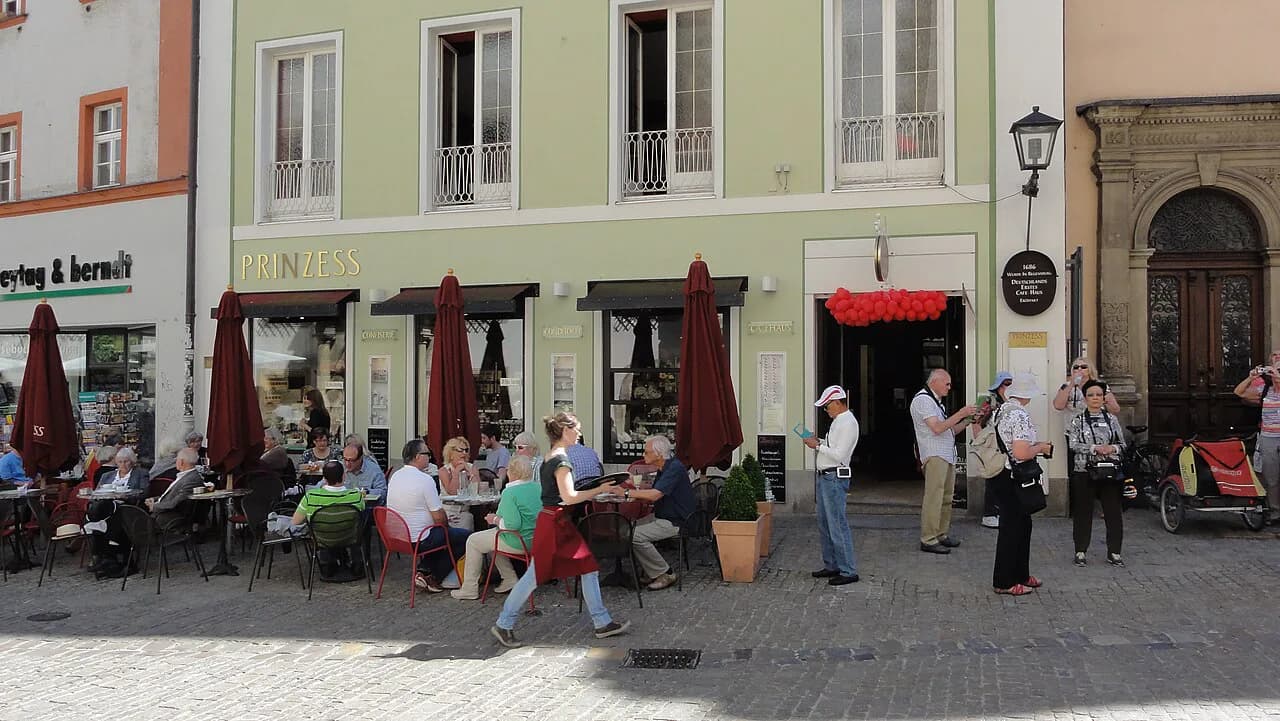
Café Prinzess in Regensburg: Germany's Oldest Coffeehouse

Café Prinzess is the coffee stop to build a Regensburg afternoon around: a Konditorei-café on Rathausplatz, directly opposite the Old Town Hall, documented as Germany's oldest coffeehouse and running since 1686. Coffee and pralines made in-house are its calling cards, and the terrace looks straight at the building where the imperial diet once met. This guide covers where it sits, what to order, how the three floors differ, and what is within a short walk.
What Café Prinzess is and why it matters
Café Prinzess occupies a spot across from the Altes Rathaus where coffee was first poured in the city in the late seventeenth century, and Ostbayern's regional tourism board calls it the oldest coffeehouse in Germany still in existence today. The house opened in 1686, just a year after Vienna's first café and decades before Berlin had one, which is why the address carries more weight than a typical café. Pralines were already being made and sold in Regensburg by 1676, ten years before the café itself opened.
The context explains the fuss: French merchants brought coffee to a city packed with envoys and princes attending the Immerwährender Reichstag, the perpetual imperial diet, and a café opposite the town hall kept them supplied. Today the family Giebelen runs the operation, in a building remodeled and renovated in 1953 and 1985. Think of it as a living piece of civic history with a cake counter, not a museum piece.
Where it is, by the Old Town Hall
The address is Rathausplatz 2, 93047 Regensburg, on the corner by the Kohlenmarkt, with the Old Town Hall and its Historischer Reichssaal next door. The Altstadt is compact and pedestrian-friendly, so you reach it on foot from most of the medieval center; the main station and the Danube are both a reasonable walk away. If you are mapping a day around the old town, this is a natural midpoint rather than a detour, and the wider Regensburg Attractions: 7 Visitor Guides collection helps you slot it against other stops.
What to order: coffee, pralines and cake from the in-house Konditorei
The specialties here are coffee and pralines, and the ground-floor Confiserie sells chocolates, pastries, cakes and tortes made in the house's own Konditorei, the confectionery workshop. Order at the counter or take a seat and go for a coffee with a slice of cake; the pralines travel well if you want something for later.
For the full café ritual, sit down rather than grab and go: a milky coffee and a torte is the standard order, and the house's chocolate work is the reason to buy a small box of pralines at the counter. If you keep your café stops short, split a slice between two people so you still have room for a meal later.
The Barbara Blomberg Torte and the praline tradition traced to 1676
If you want one named cake, ask for the Barbara Blomberg Torte, a creation of the in-house Konditorei named after the Regensburg gilder's daughter known as die schöne Barbara, the beautiful Barbara, as the coffee writer Tom recounts it. It is the specific order that ties the café to the city's history rather than being just another slice.
The praline story runs deeper than the café: Ostbayern's tourism board dates the first pralines made in Germany to Regensburg in 1676, and the café's own confectionery tradition is presented as continuous from there. Whether or not you accept every version of who invented the praline, the 1676 date and the café's own confectionery are documented, and that continuity is what makes the counter worth a stop.
How the building works: counter, café, tea salon and terrace
The house spreads over three levels, so decide what kind of stop you want before you walk in. The ground floor holds the Confiserie with the praline and cake counter, the first floor has the comfortable café, and the second floor is a Salon de thé, a tea room, for a quieter sit.
Outside, a Freisitz, or open-air terrace, faces the Old Town Hall and the Historischer Reichssaal, and it is served from Easter to October. That seasonal window matters in Regensburg's climate, so on a cold or wet day plan on the upstairs rooms instead.
With three floors plus the terrace, the practical trade-off is atmosphere versus space: the upper tea room is calmer, the terrace has the view, and the ground floor is the quickest if you only want pralines to take away. If you are combining a coffee with another beer-and-food stop, keep this one to an hour.
Hours and address
Café Prinzess at Rathausplatz 2 keeps these published hours: Monday to Saturday 10:00–18:00, and Sundays and public holidays 12:00–18:00. The contact line is 0941 595310 and the email is kontakt@cafe-prinzess.de; the café's own site is cafe-prinzess.de.
Nearby: Historische Wurstkuchl and the Steinerne Brücke
A few minutes' walk downhill brings you to the Historische Wurstkuchl, the world's oldest sausage grill, right by the Steinerne Brücke, the twelfth-century stone bridge over the Danube. Order the small grilled sausages with sweet mustard, sauerkraut and a Kümmel roll (a cumin-topped bun) as a savory counterpoint to a coffee stop.
If you would rather stay in the old town for another café stop, Café Orphée in Regensburg is another sit-down option nearby, and the city's brewery scene gives you plenty to plan around later. If dark lager and a proper brewery tap appeal, Kneitinger in Regensburg is the traditional choice, and the Thurn und Taxis Brewery in Regensburg covers the princely side of local brewing.
Is Café Prinzess worth the stop?
Yes, if you want a coffee with a story and a cake you can name: the 1686 founding, the 1676 praline record, and the Barbara Blomberg Torte give it more substance than a generic café stop. Sit upstairs for calm, take the terrace for the Old Town Hall view, and buy pralines at the counter to take with you.
Pair it with the nearby Historische Wurstkuchl and the bridge walk for a compact food-focused afternoon, and check the café's own site for the current hours before you go.
Explore more Regensburg guides
Frequently Asked Questions
Is Café Prinzess really Germany's oldest coffeehouse?
Ostbayern's regional tourism board describes Café Prinzess as the oldest coffeehouse in Germany still in existence, with an opening date of 1686. Coffee and pralines are cited as its specialties, and the café continues that tradition today by the Old Town Hall.
What is the Barbara Blomberg Torte?
It is a cake from Café Prinzess's own Konditorei, named after the Regensburg gilder's daughter known as die schöne Barbara, the beautiful Barbara, as the coffee writer Tom describes it. Order it if you want the house's named slice rather than a standard cake.
Can you sit outside at Café Prinzess?
Yes, there is an open-air terrace facing the Old Town Hall and the Historischer Reichssaal, and it is served from Easter to October. Outside those months, use the café on the first floor or the tea salon on the second.