
Zum Arabischen Coffe Baum: Leipzig's Historic Coffeehouse and Museum

Zum Arabischen Coffe Baum packs three things into one building on Große Fleischergasse in Leipzig's old center: a café, a restaurant and a coffee museum spread across 15 historic rooms upstairs. Come for the carved portal and a slice of cake, stay for the museum, or do it the other way around.
The house is described as one of Europe's oldest coffeehouses, and drink has been served here since 1711. What follows covers the entrance relief, the famous guests tied to individual rooms, the museum's themes and how much time to give the place.
What Zum Arabischen Coffe Baum is
Think of it as a layered building rather than a single venue. The ground floor and upper floors hold the café and restaurant, while the museum occupies historic rooms above the guest area. That arrangement means you can sit down for coffee and cake without buying anything museum-related, or climb straight up to the collection.
The building itself is old enough to appear in records from 1556. The café reopened in spring 2025 after roughly six years of renovation work; the museum followed on July 1, 2025. The city of Leipzig and the state of Saxony put money into the restoration, and the tenants invested in the interior and kitchen equipment.

Where it sits and how to walk there
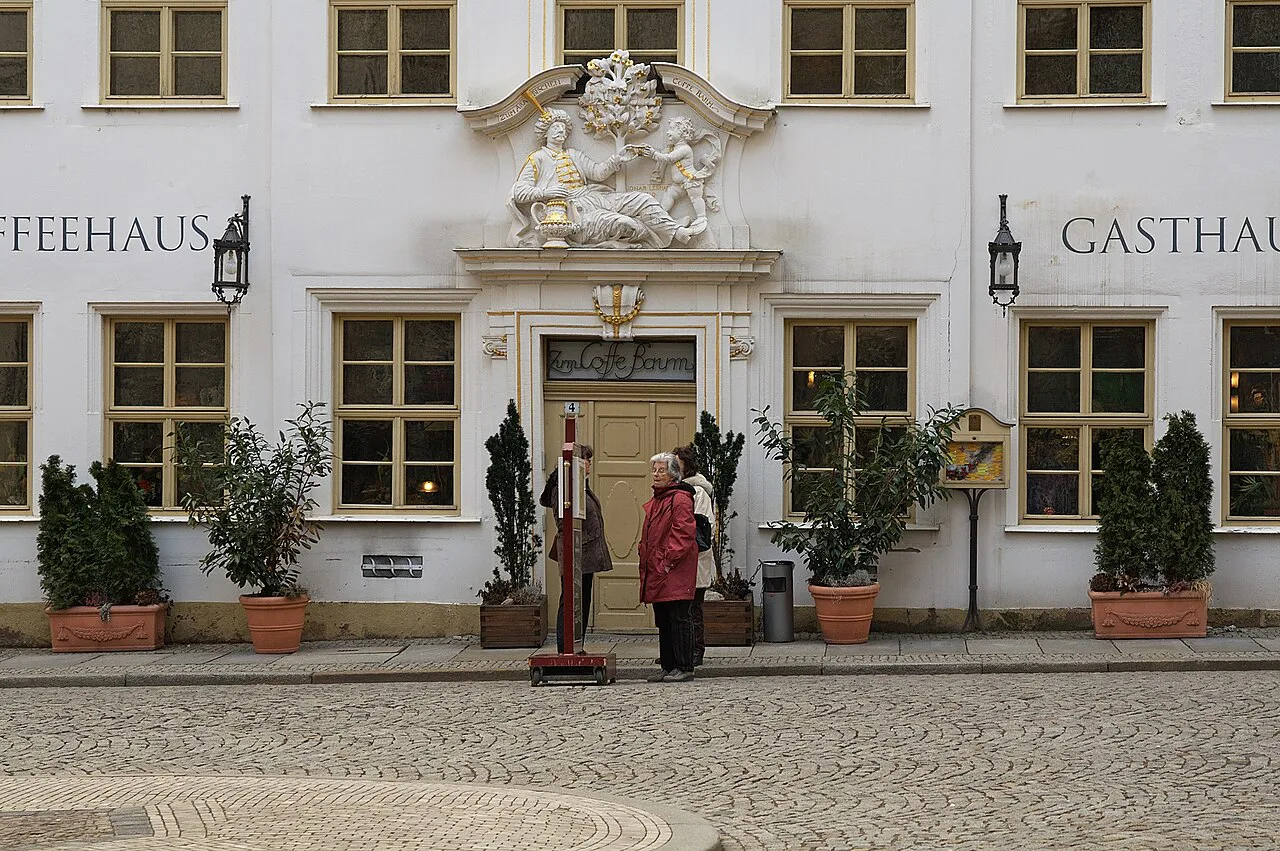
The address is Grosse Fleischergasse 4, in the tangle of lanes just north of the Markt. Come from the Markt toward the Barfußgäßchen passage and continue into the narrow streets; the coffeehouse sits on Grosse Fleischergasse between that lane and the old center.
Walking is the sensible way to arrive, since the old center is compact and the surrounding lanes are pedestrian-friendly. A small marked photo point near the building gives you the angle for a picture of the facade, which is useful because the tight street leaves little room to step back.

The portal relief above the door
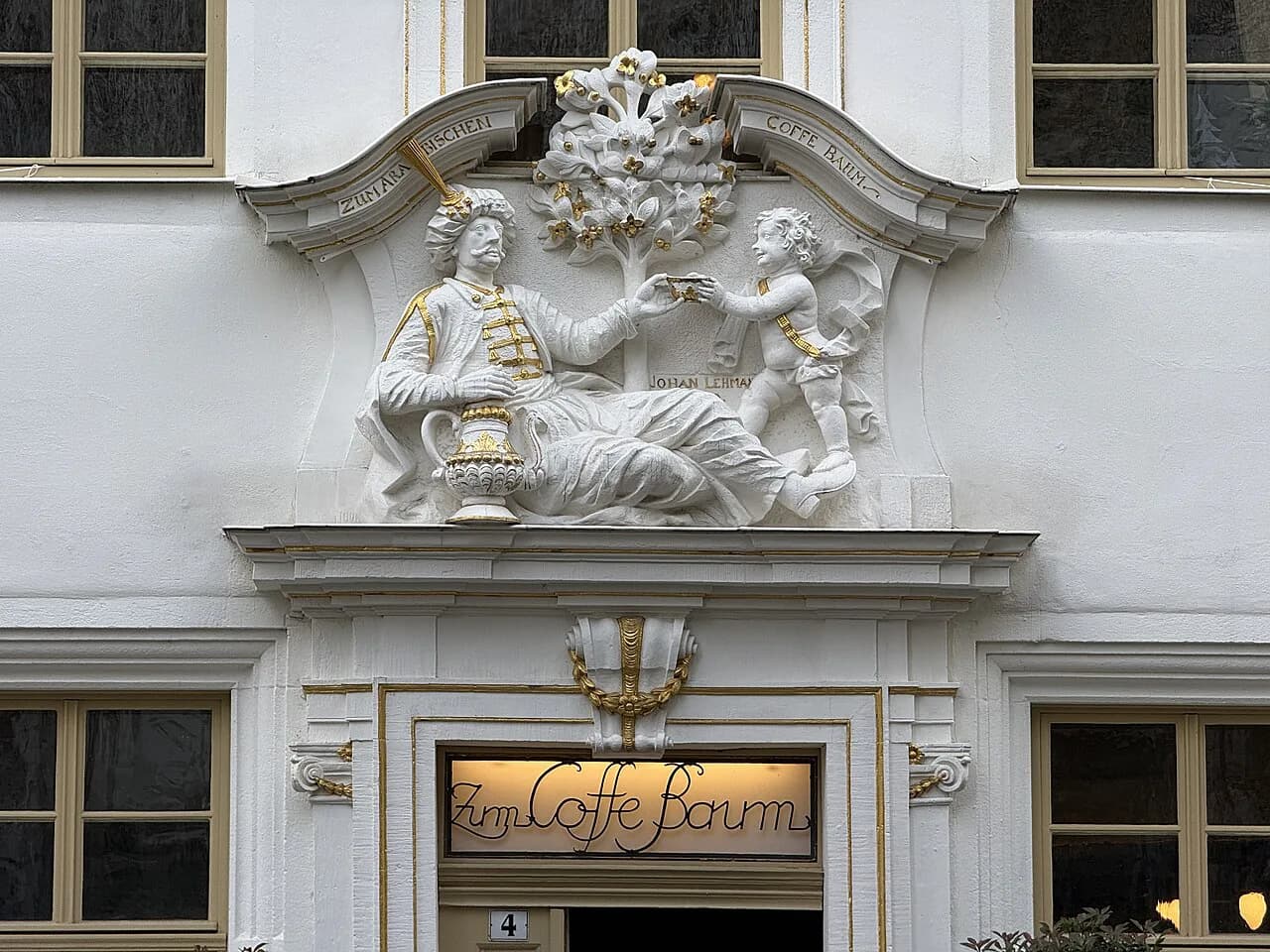
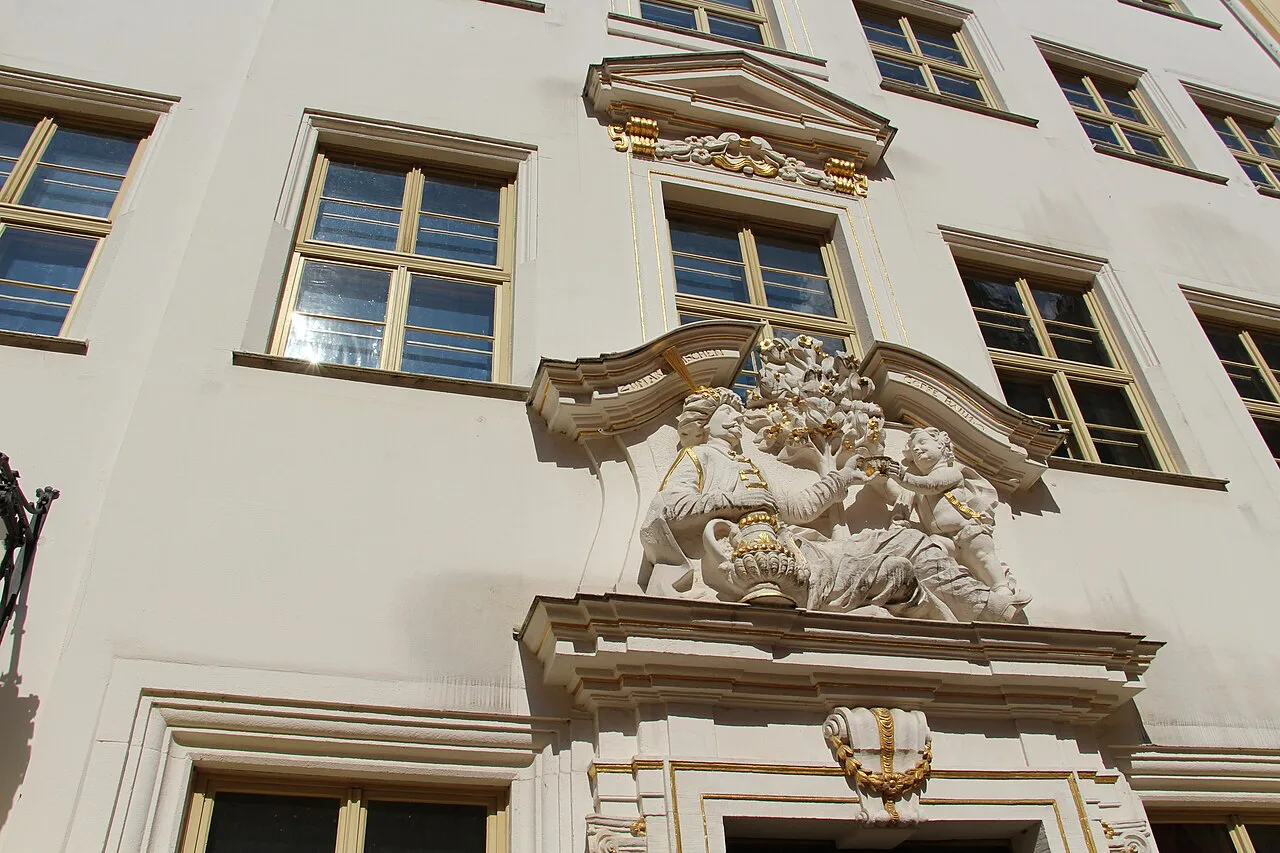
Look up before you go in. The entrance carries a relief of an ornately dressed Ottoman figure leaning on a large coffee pot, with a small cup-bearer beside him, and the house inscription runs across the door around a flowering coffee tree. The carving is read as a symbol of coffee arriving in Europe from the East.
In the 18th century the relief was painted in color and heavily gilded, so what you see today is a quieter version of a much flashier original. Give it a minute rather than a glance; it is the single best free detail at the address.
The August the Strong legend
No one has pinned down who commissioned the portal sculpture or who paid for it, and a persistent Leipzig legend fills the gap. The story goes that Augustus the Strong, elector of Saxony, had an affair with the innkeeper's wife Johanna Elisabeth Lehman and donated the sculpture in 1720 as a thank-you, with the cupid figure and the little dish of coffee read as a nod to the romance.
Treat it as house lore, not recorded history. Augustus was nonetheless among the early prominent drinkers of coffee at this address, which is the documented part of the story and the reason the legend sticks.
Famous guests and the memorial rooms
The guest list is the real draw for anyone interested in German cultural history. Johann Christoph Gottsched was a regular, as were Lessing and Klopstock; E.T.A. Hoffmann is said to have preferred a glass of Jamaica rum, and Robert Schumann came and went between 1828 and 1844, noting in his diary what he spent and whom he met.
Richard Wagner and Edvard Grieg drank here during their student years in Leipzig, and Erich Kästner was often seen in the Kaisersaal. Two rooms preserve the connection physically: the Schumann room on the ground floor marks the composer's spot, and a small Max Schwimmer room displays facsimiles of the painter's drawings and watercolors.
The line continues into the 20th century with Franz Lehár, Paul Lincke, Heinrich George, Hans Albers and Johannes Heesters, and city mayors Otto Georgi and Carl Goerdeler counted among the regulars. Between 1923 and 1933 an artists' table called Die Eierkiste met here, drawing the literature professor Georg Witkowski and the Thomaskantor Günther Ramin.
The upstairs museum
The permanent exhibition reopened on July 1, 2025, after about six years closed for restoration work, and it opened to visitors the following day. It fills 15 historic rooms above the guest area, which is why the museum takes longer than the name suggests.
The storyline is broader than porcelain and beans. Displays cover the strict coffeehouse rules of the 18th century, the coffee crisis in the DDR, and the colonial entanglements of earlier coffee growing alongside today's global trade relationships, with Bach and Schumann, Lessing and Kästner placed in the same narrative of famous guests.
Smaller in-house displays deepen the history for anyone who wants more after the main rooms. Leipzig-Lese, drawing on the Stadtgeschichtliches Museum Leipzig, notes that these rooms hold facsimiles and background on the house's past, so budget a little extra time if you read everything.
Seating, cake and what to order
The café and restaurant spread over several floors, and tables fill quickly at busy times. If the ground floor is full, ask staff about seating upstairs rather than hovering by the door, and expect to be placed at a shared or small table when the room is packed.
The torte buffet is the thing to scan first. In April 2025 it listed Eierschecke, a Saxon baked layer of quark, custard and yeast base, at 4.90 euros, a Schwarzwälder Kirschtorte at 6.50 euros and a MoccaKirsch at 5.90 euros; treat those as 2025 prices and read the current counter before you commit.
Order a Kaffee with the cake and you are following the house's own logic, since coffee is the reason the building exists. Ask at the counter what is being served that day instead of assuming the buffet looks the same as last season.
How long to allow
Two speeds work here. A quick visit of about ten minutes covers the facade, the portal relief and a coffee at the counter; a fuller visit of an hour or more pairs the 15 museum rooms with a sit-down coffee and cake.
The trade-off is simple: the museum rewards people who read labels and care about the DDR coffee story, while the café rewards anyone who just wants a historic room and something sweet. If you are traveling with someone who has no patience for display cases, split up and meet at the torte counter.
Nearby in the old center
The Markt and the Nikolaikirche are a few minutes on foot, which makes the coffeehouse an easy stop in the middle of a walk through the center. Auerbachs Keller in Leipzig sits in the Mädler Passage nearby, another historic address with its own literary history, and the Bayerischer Bahnhof Leipzig is a short ride away if you want a brewery-restaurant later in the day.
For a wider plan of the city's food landmarks, the Leipzig Attractions: 5 Visitor Guides collection puts this coffeehouse alongside the city's other historic eating addresses. Barthels Hof Leipzig, a restored trade courtyard with a restaurant, is another old-center stop within walking distance.
Museum ticket or just a slice of cake?
Choose the museum if you want the 15 rooms on coffeehouse rules, the DDR coffee crisis and colonial trade, and plan on an hour with a coffee afterward. Choose the café alone if your interest is the carved portal, the old rooms and a slice of Eierschecke.
Either way, walk the Grosse Fleischergasse entrance slowly, look up at the Ottoman figure, and decide at the door how much of the building you want. The house's own site and the notice board at the entrance are where current visitor details are posted.
Explore more Leipzig guides
Frequently Asked Questions
Is Zum Arabischen Coffe Baum the oldest coffeehouse in Europe?
It is described as one of Europe's oldest coffeehouses, and drink has been served in the house since 1711. Treat claims of an absolute record with care and enjoy the building for what it plainly is: a very old coffeehouse with a museum above it.
Do you need a ticket for the museum, and is it separate from the café?
The café and restaurant and the museum are separate operations in the same building, so you can sit down without visiting the exhibition. The café reopened in spring 2025 after a long renovation, and the museum reopened on July 1, 2025, filling 15 historic rooms. Admission details are posted at the house and on its own site.
What does the name Zum Arabischen Coffe Baum mean?
It translates as "At the Arabian Coffee Tree," and the entrance relief makes the reference literal: an Ottoman figure with a coffee pot stands beside a small cup-bearer and the house inscription includes a flowering coffee tree. The image is read as coffee arriving in Europe from the East.
Can you visit the café without going to the museum?
Yes. The café and restaurant occupy the guest floors and the museum sits above them, so a coffee and a slice of cake is a complete visit on its own. If tables are full, ask staff about seating on the upper floors.